Chinese language program cut at UMW
3 min read
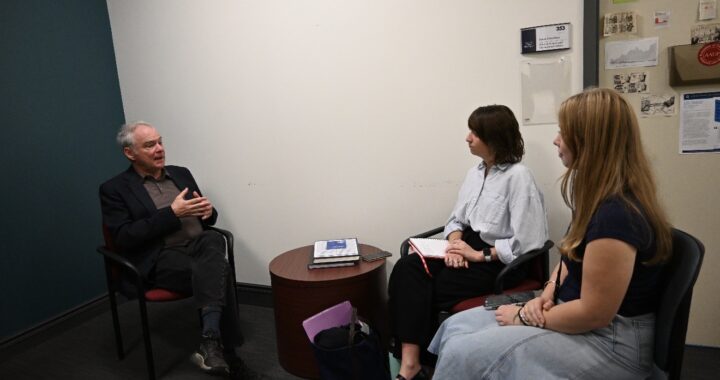
Students currently enrolled in a Chinese class will be left without the ability to complete the full program. | Abbey Magnet, The Weekly Ringer
by ELIZABETH KYNE
Staff Writer
After over two decades of Chinese language instruction at UMW, the university is ceasing Mandarin course offerings.
The Department of Modern Language and Literature urged the administration to reconsider in an open letter to staff signed by their chair, Marcel Rotter. The letter called the choice “a very troublesome development here at UMW, and one that could cause serious damage.”
The Language Department believes this change is due to budget cuts.
“The small savings from cutting these low-cost adjunct-delivered courses could cause the university to lose students, and revenue,” says the letter. Its authors believe “small savings from cutting these low cost adjunct delivered courses” are not an effective way to deal with the financial issues caused by low enrollment to the university.
Adjunct Professor Hope Tang has taught Chinese language and culture courses at Mary Washington for 13 years. In light of the recent drop in interest in Chinese courses, with Mandarin 102 having only seven students enrolled, she primarily takes on students for individual studies to privately continue their education.
There is a feeling of being cheated out of the full experience amongst some students currently enrolled in the program.
“They’re leaving before I get to complete it or leaving before I get to finish it, and my experience when I took German with UMW last year was not like that at all,” said junior historic preservation major Sam Luther.
The Chinese program has played a role in campus events, but has faced notably lower enrollment and now removal from the language course offerings. Tang says recent geopolitical events played a role.
“After COVID-19, the Chinese government gives American people or the international society some negative impressions,” she said. “People don’t have a good impression of the Chinese government.”
The Language Department’s letter agrees that “hostile rhetoric” between America and China has contributed to low enrollment.
Luther shared similar sentiments and said the decision feels “pointed.”
“I already felt a bit of the side eyes from people, like, ‘Oh, you’re taking Chinese?'” he said.
There has been tension between China and America for some time now. A report released by California State University measuring 24 major cities from 2020 to early 2021 found an 189% increase in anti-Asian hate crimes. Stop APPI Hate has tracked a 58% spike in violent threats found online against Asians following the 2024 election of President Donald Trump. Similarly, the debate surrounding the Trump Administration’s TikTok ban has contributed to increased hostility towards the Chinese government, which some argue leads to increased xenophobia and fear-mongering.
According to Tang, Chinese cultural courses are often unintentionally put in competition with Japanese courses due to the fascination with Japanese culture among younger people. She notes that the popularity of Japanese media in America has affected Chinese enrollment rates.
“Our younger generations liked playing video games and watching Japanese anime… they say ‘we like Japanese culture, we want to travel to Japan,’ so Japanese is more welcomed and popular for the younger generation,” she said. “Maybe that’s why the students choose Japanese. I never blame the Japanese program, but it is a fact that these two programs have a hard time surviving.”
When reached for comment, Heather Pham, co-president of the Asian Student Association said she was “deeply disappointed” by the choice, saying it “directly contradicts the university’s commitment to diversity” and saying the change “may discourage minorities from applying to the university and prevent many educational opportunities.”
The Language Department’s letter notes that removing Mandarin as a language will limit the Asian Studies minor to only offer Japanese for fulfilling requirements. Mary Washington students are not the only ones who may feel the loss, as the removal of Mandarin could end exchange programs with Chinese Northwest University.
“They are interested in Chinese culture…it’s very sad, very disappointing for our students,” said Tang.
Tang is involved in the Asian cultural affairs on campus and the larger Rappahannock River Area Chinese Community, including Fredericksburg, Stafford, Vineyard, King George and Orange County. The Fredericksburg community has been entwined in Mary Washington’s school events, often attending as performers and lecturers or providing food service. Most catering and performances at the recent Lunar New Year event were from the Fredericksburg Chinese community.
“You cannot imagine next year if we don’t have any Chinese program,” said Tang. “Our Lunar Celebration—no Chinese performers, no Chinese food. What kind of events? Nothing. Events would be very, very small.”