Chain blocking popular desire path vandalized by students unhappy with change to campus landscaping
3 min read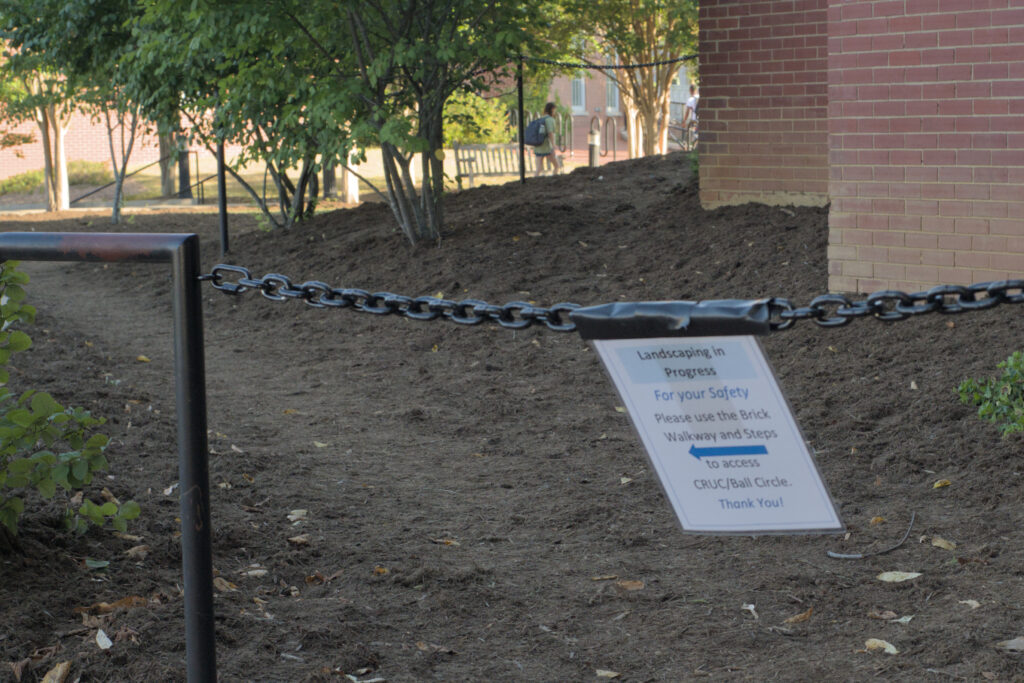
UMW Facilities Operations closed the popular desire path between the CRUC and Custis Hall with a chain on Sept. 4. | Violet Ayers, The Weekly Ringer
by KY HUYNH
Executive Editor
A few weeks after the chain-link fence spanning between Custis Hall and the University Center was installed and blocked a popular desire path, students began finding ways to get around the obstruction, some taking it upon themselves to cut the chains down.
Allen Queen, a senior international affairs major, occasionally walks on the desire path and believes that seeing students take direct action to remove the chains can be useful, only until vandalism occurs.
“I think that students taking action shows how the path is actually useful,” he said. “I do not agree with vandalism at all and think that it will only cause more issues, but I also don’t see why the fence couldn’t have been put closer to the edge to allow the path to still be used.”
He continued, “We should be voicing our concerns, not vandalizing.”
Ben Kopach, a senior geospatial analysis major, believes the student response has been warranted as they advocate for change and seek to navigate campus.
“I think students are taking action because it’s a popular path that avoids going downhill and then going up stairs,” he said. “It also saves a minute or so.”
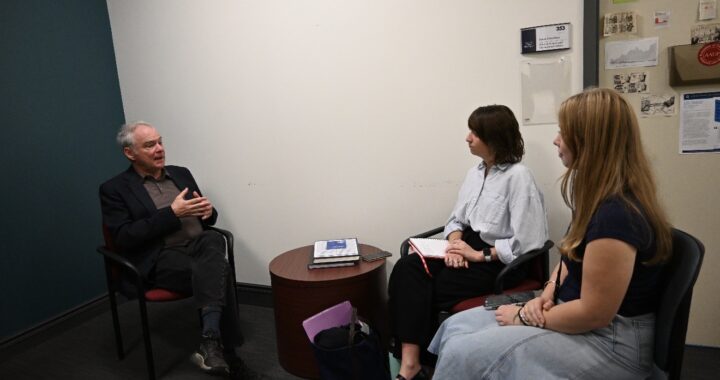
UMW Chief of Police Michael Hall says that his office is aware of students’ concerns about the future of the desire path. However, he says the university currently has no plans to permanently take the chains down.
“The students spoke out by taking the chain-link fence down,” said Hall. “It was put back up because there are currently no plans in place right now of how do we navigate through this.”
He continued, “So as a result of those concerns and the moving of some of the rocks, the director of facilities and the SGA president have entered into conversations of finding the best solution to the students concerned.”
Assistant Vice President of Facilities Brian Gorham says that the Facilities Operations team has met with UMW’s Student Government Association several times to discuss the landscape project and receive feedback from students.
“The chains remain for now as a measure of attempting to reduce impact to the new landscaping as it is installed,” he said. “Once restored, the area will be reopened as a greenspace on campus.”
Amira Said, SGA president and senior environmental science major, also confirmed that conversations between elected student representatives and facilities are ongoing.
“I think the reason students are taking action is because they, we, care,” Queen said. “It is a path which has not caused any problems during my time here at UMW, but all of a sudden it is.”
He also believes that the university is listening to students and thinks that vandalizing is not the way to a solution.
“I think they are definitely listening and are willing to talk, but I feel like it will end up being a dead-end,” he said. “I also don’t think that people vandalizing the fence helps either because it won’t solve issues and will create more problems.”
Kopach says the university must choose the most beneficial solution for the community, or students will continue to find their own workarounds.
“The school has two choices, wall it off in such a way that makes it impossible to go that route or put down a proper path that won’t degrade, whether that’s a sidewalk, permanent mulch, etc,” he said.
Hall says the university is working on a solution and that continued vandalism could cause a more negative impact.
“You wanted your voice heard. Now your voice has been heard. Give it a minute,” he said. “Take a pause and allow that to work through.”
According to Gorham, a new landscape plan will be completed over Fall Break and will include shrubs and small caliper trees along the raised wall, which will serve as a natural border along the desire path.
“We continue to explore options for pathways and railings, but it would require extensive reworking of the landscape and structures, requiring appropriate engineering, adherence to ADA requirements and an understanding of the significant costs,” said Gorham.