Financial barriers inhibit access in studio art
4 min read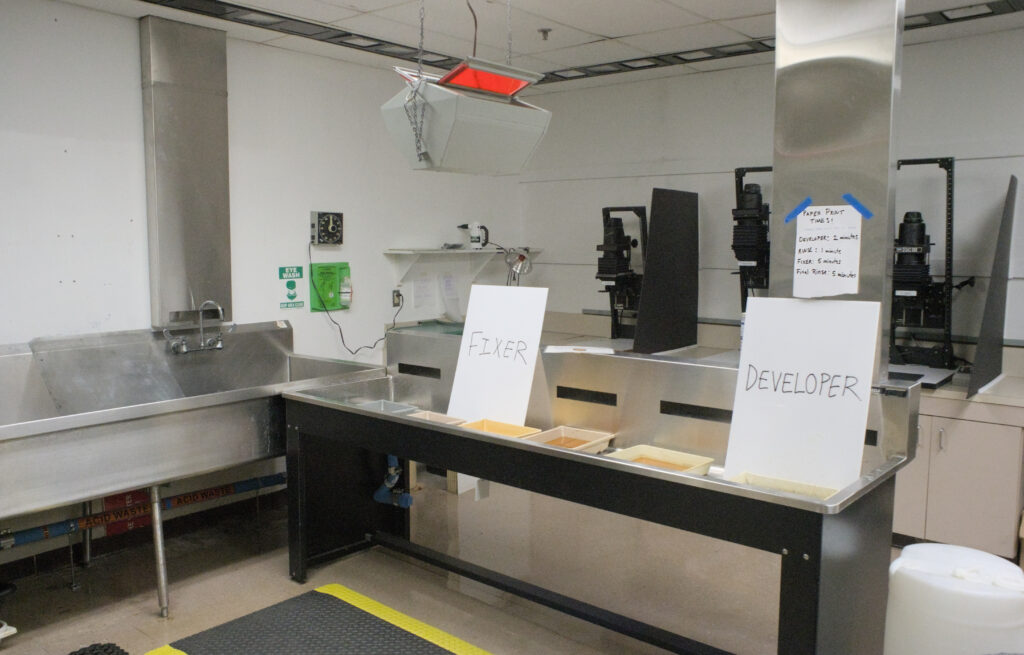
UMW’s dark room, located on the second floor of Melchers Hall, is available to all photography students. | Violet Ayers, The Weekly Ringer
by VIOLET AYERS
Photo Editor
Before I took Photography 1, I was warned it would be expensive. The class required me to obtain archival film sleeves, 10 rolls of film, 50 to 100 sheets of photo paper and most importantly, a film camera with full manual settings—something that very few major manufacturers have produced in the last 20 years.
Materials required for studio art classes can be expensive and difficult for students to source and more could be done to help alleviate these costs. If professors were better able to provide resources to students, and students were more proactive in looking for resources, these issues could be improved.
These challenges are not necessarily the studio art department’s fault, since high-quality art supplies are expensive and niche art forms require specialized gear. If I want to shoot a roll of film, it’s going to cost at a minimum around $5 to $8 for a 36-shot roll. If I want to actually develop that film, I would need to pay a lab somewhere around $10 to $30, or I would need to have the gear to develop it myself.
Developing film in a dorm room is, surprisingly, relatively feasible, but actually making photographic prints from that film is a different story. Doing so requires large and expensive equipment, good enough ventilation so that you don’t inhale the potentially toxic chemicals and an effectively light-proof working space so as not to ruin your photo paper.
In this regard, studio art classes can make art a lot more accessible. Melchers has a darkroom with a proper ventilation system, a fleet of film enlargers and safe working lights that can’t damage your work. Despite this, getting the materials for classes remains an obstacle.
“There’s not really stores that exist that you can just go into and be like, ‘hi. I would like code six fire glaze,’” said Nina Cherry, a junior studio art major. “You have to buy it online, and a lot of the things online are really bad unless you buy the professional stuff that’s in bulk because it’s professional.”
For students taking a few studio art classes for fun, this might be a relatively minor issue, but for those in the major who are required to take a variety of studio art classes, such issues can compound.
“When you’re trying to enter the major, you’re taking a lot of classes like, you know, design principles and sculpture one or something like that, and so you’re going to be buying bags of plaster and like whole spools of wire, and you’re gonna use it for one whole project,” said Cherry.
According to junior studio art major Vic Koutsouftikis, who is also a studio aide and president of the Student Art Association, resources to mitigate the costs for at least some art classes do exist, but people may not know about them.
“I think it’s also just like students are told by professors at the beginning of the semester, ‘we have a limited amount of free stuff, so please go out and get your own stuff for this class because I can’t give you away all this stuff,’ and then they don’t actually go to the students who may be struggling and be like, ‘hey, I do have some stuff for free for you.’” said Koutsouftikis.
Being more proactive in reaching out to students who are struggling with their materials would definitely help, but professors’ budgets are limited and can’t just cover excess materials for students. Providing more funding to the studio art department could definitely help alleviate these issues. If supplies were less limited, more students could be helped and students would likely feel less bad about taking from these limited supplies.
Another way to help students with their art materials is to look for supplies which already exist in and around Melchers.
“I’m still finding new things about this building, like all the time,” said Koutsouftikis. “If a professor is a newer one, how are they ever meant to know the nooks and crannies, or where people keep the extra supplies.”
Melchers itself isn’t the only place where students can look for supplies. Cherry claims that they haven’t spent a single cent on their woodshop class, as they’ve been able to find plenty of wood in dumpsters on campus.
Additionally, according to Koutsouftikis, on-campus clubs such as the Student Art Association may be able to help with sourcing materials or learning skills for specific art projects.
Art is expensive, and the cost of studio art classes reflects this. My experience with studio art has been a good one, yet there are a variety of things that students, professors, and the school could do to make costs more manageable.