Faculty decide snow day class procedures in new policy
4 min read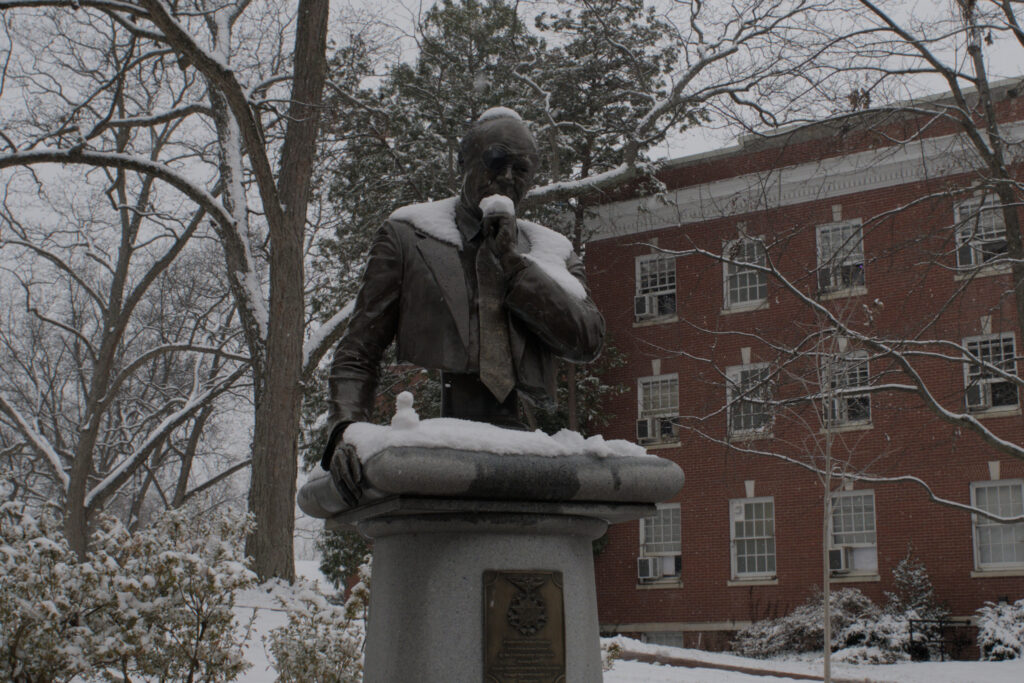
Professors can now decide whether or not to hold online classes or alternative classes on snow days. | Violet Ayers, The Weekly Ringer
by CAROLINE PREUSS
Staff Writer
Starting this spring semester, professors will be permitted to hold classes in alternative formats during inclement-weather closures, according to an email sent by Executive Director of University Communications Amy Jessee on Jan. 9.
During such closures, in-person class meetings will not take place. Faculty members will instead have the discretion to move classes to another format or assign alternative work, including holding classes virtually. If virtual instruction includes a synchronous meeting, it must take place during the regularly scheduled class time.
“Many faculty already made decisions to cancel class, extend an assignment or change how class sessions would be made-up during inclement weather changes to the schedule,” said Jessee. “This update notes these practices and reminds students to check for class changes during inclement weather as well as assess the weather conditions in their locations for any impacts.”
Faculty are responsible for communicating any changes to students. The policy also emphasizes that students may not be penalized if they are unable to attend virtual classes or complete assignments due to weather or technology issues.
Updates on closures, delays and schedule changes will be shared through UMW email and posted on the university’s website, which will continue to serve as the primary source of information during inclement weather.
Students and employees are encouraged to assess weather and road conditions in their own locations. If campus operations remain normal but travel is impacted by weather, individuals should contact instructors or supervisors to make arrangements for missed classes or work.
“This update offers academic continuity and flexibility for faculty and students during inclement weather changes,” said Jessee. “We appreciate the feedback from the campus community and the input through academic leadership including Provost’s Council and Cabinet as we made our messaging more consistent with practices on our campus and with colleges across the state.”
Associate Professor of German Marcel Rotter said he supports the university’s decision to allow alternative class formats during inclement weather, particularly when it helps maintain academic continuity.
“I prefer to do it online rather than canceling it,” said Rotter. “Especially when you’re working toward something, two snow days can really throw everything off.”
At the same time, Rotter acknowledged that virtual instruction during severe weather may not be equally accessible for all students, particularly those who commute or live in areas with unreliable internet or power.
“For students who live on campus, it shouldn’t be a problem, but commuters are the issue,” he said. “During Covid, I had a student who had to drive to his grandparents every time we had class because they had internet and he didn’t at home. I don’t know how much better that situation is now.”
Students are pointing out similar challenges with access and expectations during severe weather.
“For some students, internet access and power outages are real concerns, and that can make online classes rather stressful than helpful,” said freshman Madeleine Gillikin. “Even if professors say students won’t be penalized, there is still pressure to keep up or not fall behind.”
She continued, “One professor might cancel, the other might hold a Zoom class, and that inconsistency can be stressful too.”
Despite concerns about access, others said the new policy offers important academic benefits during weather-related closures.
Evan Sowards, a junior cybersecurity major, said he views the policy as a reasonable and flexible approach to snow days.
“The policy seems rather reasonable to me,” Sowards said. “I found the stipulation that students can not be punished for not attending virtual meetings to be surprisingly forgiving and the fact that there is no mandate to do virtual class is nice.”
Sowards also noted that online instruction could improve safety for students who commute.
“The option of online is a great benefit for commuter students,” said Sowards. “I believe we had an instance some time in the past where snow caused the unfortunate passing of a student, so being able to give commuters more leeway seems like a great idea to me.”
Other students expressed similar views, saying the policy helps them stay on track academically during severe weather.
“I think it’s actually a really good option, because our education shouldn’t suffer because of the weather,” said freshman Awa Fall. “Education is so expensive, so I think we should be able to have class no matter what.”
While she supports the policy overall, Fall said clearer communication about how it will be implemented during inclement weather would be helpful.
“I wasn’t even aware of the policy until now. I feel like the university should talk about it a bit more,” she said.