UMW quietly removes gender neutral bathroom designation in several buildings
5 min read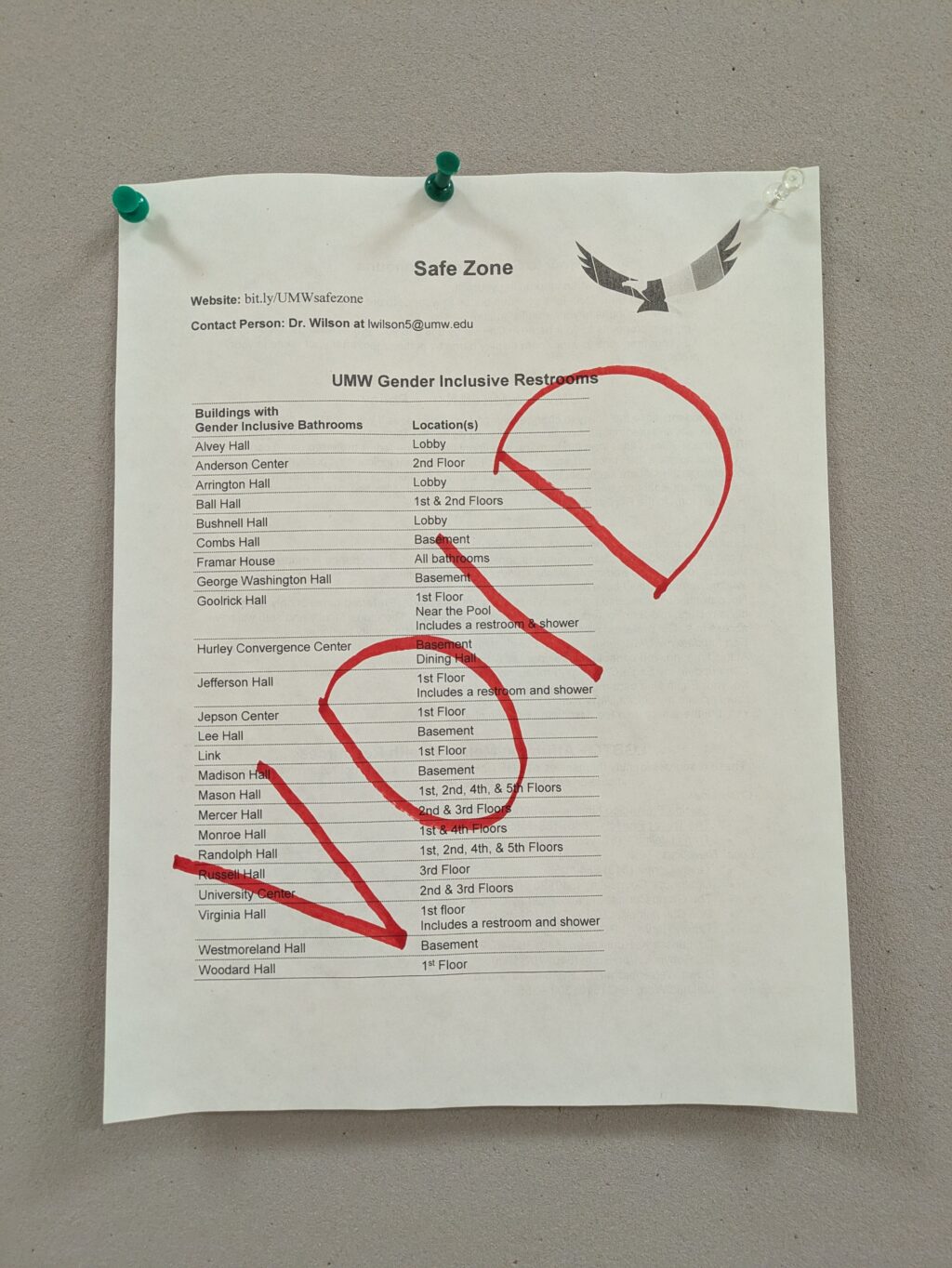
After the withdrawal of several gender neutral bathrooms across campus, professors deemed the Safe Zone list of gender neutral bathrooms to be void. | Ella Cordle, The Weekly Ringer
by ELLA CORDLE
Opinion Editor
At the beginning of the 2025 Fall semester, Yzabel Ilao, a senior English literature major, walked to the basement of Combs Hall and went to the restroom before her class began.
Ilao knew there was a multi-stall bathroom available to her on that floor, so she made her way there and began to walk in when something caught her eye.
The sign outside the door that had once designated the restroom as gender-neutral now read “WOMEN,” accompanied by the classic icon of a stick figure wearing a dress.
While this new designation made no difference to Ilao personally, it did make her think about transgender students and whether UMW is as inclusive as it touts.
“Since our current administration has been doing some DEI rollbacks on college campuses, I wasn’t surprised that this was happening,” Ilao said. “Although it did feel a little unreal that they changed the sign because mostly everyone in the English Department wants everyone to feel comfortable and okay with their gender identity.”
UMW has long been considered a queer safe haven and is currently ranked as 21st in the nation by the Princeton Review for its support for the LGBTQ+ community.
This change is not exclusive to Combs Hall. Within the last year, UMW has converted many gender inclusive bathrooms into women’s bathrooms or family bathrooms.
“I know some people might think ‘It’s just a bathroom sign,’ but this is actively erasing the existence of gender-nonconforming students by not acknowledging their identities,” said Ilao. “Hopefully, UMW will do better by taking accountability for what they’ve done and improve as an institution for their students and faculty. I want to believe that this institution is better than that.“
Outside the professors’ offices on the third floor of Combs Hall, a list of all gender-inclusive bathrooms on campus compiled by Safe Zone, UMW’s LGBTQ+ ally program, is posted on a bulletin board. Recently, Mara Scanlon and Kate Haffey, both professors of English, wrote across the list in large red letters, “VOID,” to highlight that the inclusivity promoted on this list is no longer accurate.
The list, published by UMW’s Safe Zone, includes 12 non-residential buildings, each with at least one gender-inclusive bathroom. The list includes singular bathrooms that are either labeled as family restrooms or otherwise indicate they’re gender-neutral, as well as multi-stall gender-neutral bathrooms.
Today, six of these buildings have no gender-neutral bathrooms. Of the buildings with gender-neutral bathrooms, none are multi-stall and only two specify gender-inclusivity.
One is in the basement of George Washington Hall, which houses only administrative offices, and has a sign that says, “all gender restroom” and a wheelchair symbol, rather than gendered icons.
The other is on the fourth floor of Monroe Hall, and while the bathroom sign features gendered icons, it also reads, “unisex.”
There are multiple gender-neutral bathrooms in the Cedric Rucker University Center, all of which have a male and female icon on the sign and no wording.
Every other building on the Safe Zone list has gender-neutral bathrooms labeled as family restrooms, many of which also include icons of a man and woman holding hands with a child between them. However, the family restrooms in Mercer Hall are both indefinitely closed, leaving another building without any gender-neutral restrooms.
There are multi-stall women’s bathrooms that were previously labeled as gender-neutral in at least Combs Hall, Monroe Hall and Jepson Hall. In all three instances, the sign reading “Women” does not match the sign for the men’s restroom, and an outline on the wall where the old sign used to be is visible. There was also a gender-neutral bathroom in Woodard Hall, but it was converted to a men’s room instead.
Despite how significant changes to UMW’s gender-neutral bathroom landscape have been, there is no official confirmation on the architect of the changes. Professors and staff were not notified of any changes, and many hadn’t noticed them.
The chairs of both the English and historic preservation departments, located in Combs Hall, said they were unaware of any changes to bathroom signage. The office manager and building coordinator of Combs Hall, as well as multiple professors housed in the building, mentioned that they had noticed the changes but had not been informed of them and had no information about them.
Currently, the Safe Zone flyers featured across campus have not been updated and fail to properly communicate recent changes to bathroom signage and staff contacts.
Laura Wilson of the psychology department is listed as the contact for an outdated version of the Safe Zone list, but stated she stepped down from Safe Zone last May to focus on other service work across campus. Therefore, she has not been involved in any discussions or decisions regarding the changes.
In the early 2010s, there was a growing movement to install gender-neutral bathrooms on university campuses. Around 2014 and 2015, cities across the U.S. began issuing laws that required gender-neutral signage on single-occupancy restrooms. In response to that, several states began to introduce bills that required transgender people to use the bathrooms that correspond with the gender they were assigned at birth. As a result, cities and states, including Philadelphia and Washington State began to double down with laws that supported transgender people.
According to a 2016 article published by The Weekly Ringer, UMW has had gender neutral bathrooms across campus for at least a decade.
When President Donald Trump took office in Jan. 2025, he issued a series of executive orders designed to target diversity, equity and inclusion programs. Among these was a statement that only recognizes two genders and denounces gender ideology. As a public university, UMW is subject to government decrees.
Many students and staff alike have speculated that the changes to UMW’s bathrooms reflect the changing political landscape.
Scanlon believes it is UMW’s responsibility to continue supporting gender-nonconforming students.
“In my opinion, we never had adequate gender neutral bathrooms for the population of our school as it was, and I think it disrespects our trans, nonbinary, and queer population, and puts them in a very uncomfortable position, to close the ones we did designate,” she said.
She also brought up UMW’s recent recognition of LGBTQ+ support by the Princeton Review.
“How can we take pride in that excellent fact when we make it difficult for some people to even take care of basic bodily needs in our buildings?” Scanlon said.
Celia Golden, a senior communication and digital studies and religious studies double major, expressed similar sentiments.
“It hurts everyone for those bathrooms to not be openly advertised as gender neutral,” Golden said. “But especially as a university with such an outspoken queer population, I feel like it doesn’t reflect UMW’s values.”