UMW celebrates the 100th anniversary of Devil-Goat Day
4 min read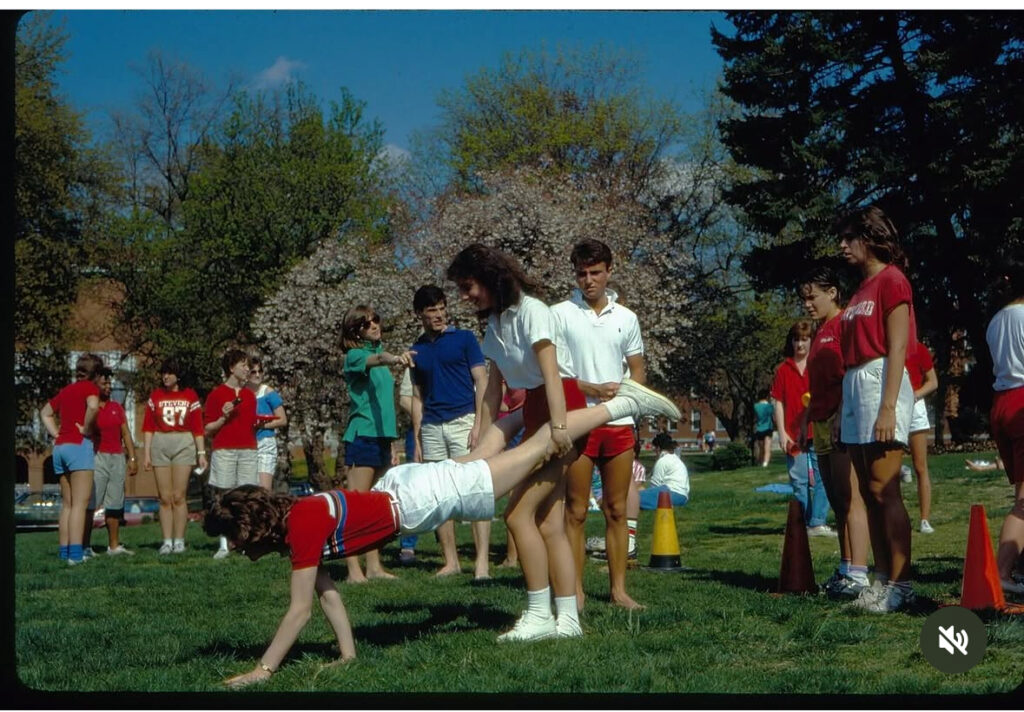
Devil-Goat Day’s rich history goes back a century. In 1986, UMW students gathered on Ball Circle for a wheelbarrow race. Fun competition continues to be a crucial component to the tradition. | @devilgoatday.archive / Instagram
by ALEXA DELACONCEPCION
Staff Writer
On April 23, UMW students will trade their typical routines of going to class and studying at home for rivalry and fun, as they divide into Devils and Goats for a competitive tradition that has shaped campus life for a century.
What began as a small, class-based rivalry has grown into one of UMW’s most recognizable and memorable traditions.
Devil-Goat Day dates back to 1926, when faculty member Kramer Dodd sponsored the junior class. The class selected the goat as their symbol, prompting seniors to choose the devil and ultimately sparking a rivalry that would define the campus tradition for years.
Eventually, alternating classes were formally designated as goats or devils, and competitions between class years gradually evolved into what is now known as Devil-Goat Day.
While today’s event is concentrated into just an afternoon of activities, it was not always coordinated this way. In its earliest years, competition between devils and goats was spread throughout the entire academic year.
That year-long format is something senior anthropology and historic preservation double major Makayla Bowman, a student researcher in the library’s Special Collections and University Archives, explored in her exhibit commemorating the tradition’s 100-year history.
“Similar to how the Hogwarts houses in Harry Potter would compete for points throughout the year, Devils and Goats would compete in sports games like volleyball, field hockey, and basketball spread throughout the year and kept track of the points cumulatively,” Bowman said. “After the tradition was reduced to just the last Thursday of classes, Devil-Goat Day would begin as early as 6:00 a.m with races and hunts similar to capture the flag.”
Bowman noted that the structure and tone of the event have changed in response to broader historical and cultural moments, such as World War II, the university becoming coeducational in 1972, economic challenges in the early 2000s and the COVID-19 pandemic.
Both Bowman and Associate Vice President for Alumni and Donor Engagement Mark Thaden highlighted the late 1980s and early 1990s as a period when Devil-Goat Day began to lose momentum, partially due to a lack of funding.
In response, first-year class officers reimagined the event by introducing music, climbing walls, jousting, inflatable games, and the signature tug-of-war competition.
“If there had not been rejuvenation efforts made by the students back in the 1990s, I think it’s possible that the tradition would not be as prominent as it is today,” Thaden said.
The students’ initiative to save our beloved campus tradition is a key reason why Devil-Goat Day remains annual, while other traditions have faded out, according to Thaden.
“I think the tradition has lasted for two reasons,” Thaden said. “First, it’s unique to Mary Washington. It’s one of those ‘if you know, you know’ situations. Also, there is pride associated with being either a Devil or a Goat, and it builds camaraderie with classmates.”
Bowman also emphasized the emotional connection students form with the event.
“Devil-Goat Day is something so unique to UMW, and it demonstrates the consistency of the fabric that ties together all UMW students, alumni, and faculty,” she said.
That emotional connection extends beyond a single day of competition. For many alumni, Devil-Goat Day remains one of the most memorable parts of their college experience. Traditions like tug-of-war, wheelbarrow races and even mechanical bull riding have left lasting impressions, with some alumni, according to Thaden, recalling the excitement of lining up early just to secure a Devil or Goat T-shirt.
“Strong traditions create cherished lifelong memories,” Thaden said. “When they come back to visit campus, they can picture themselves in the middle of Ball Circle with their friends and classmates competing for the win.”
For current students, however, Devil-Goat Day is often less about its origins and more about the experience itself.
“In my opinion, it is more about the experience because it’s an opportunity to meet new people and truly connect more to my campus,” said Leiauna Copeland, a freshman psychology and history double major.
Like many others, she also emphasized the sense of community that comes with participating, noting that even casual involvement can make people feel more at home.
“It reminds me of elementary school field days,.” said Copeland.
At the same time, not all students enjoy Devil-Goat Day in the same way. Some see it as more of a social event than a meaningful tradition, choosing to participate selectively or not at all.
“I don’t actually care which side wins, I’m just there to have fun and be with my campus community and friends,” said junior communication and digital studies major Emma Lusk.
The balance between competition and inclusivity is part of what continues to set Devil-Goat Day apart from other traditions.
“Devil-Goat Day demonstrates that Mary Wash is a place that fosters lighthearted competition,” said Bowman. “At the end of the day […] we’re all Eagles.”
As the university prepares for the 100th anniversary, that sense of connection is especially significant. Reaching a century is not just a marker of time, but a reflection of the continued effort by students and the university to keep the tradition alive.
Bowman, reflecting on her research and personal experience, expressed confidence that Devil-Goat Day will continue to evolve while maintaining its core identity.
“The Devils and Goats have always persisted,” she said. “I’d like to believe that they will continue to persist for another 100 years.”
Thaden shared a similar perspective, emphasizing the continued enthusiasm surrounding the event.
“It’s part of the fabric of the student experience,” he said. “I do not see that changing anytime soon.”
As April 23 approaches, students will once again choose sides, gather on Ball Circle, and take part in a tradition that has connected generations of Mary Washington students.