New exhibit spotlights untold stories of first Asian students
5 min read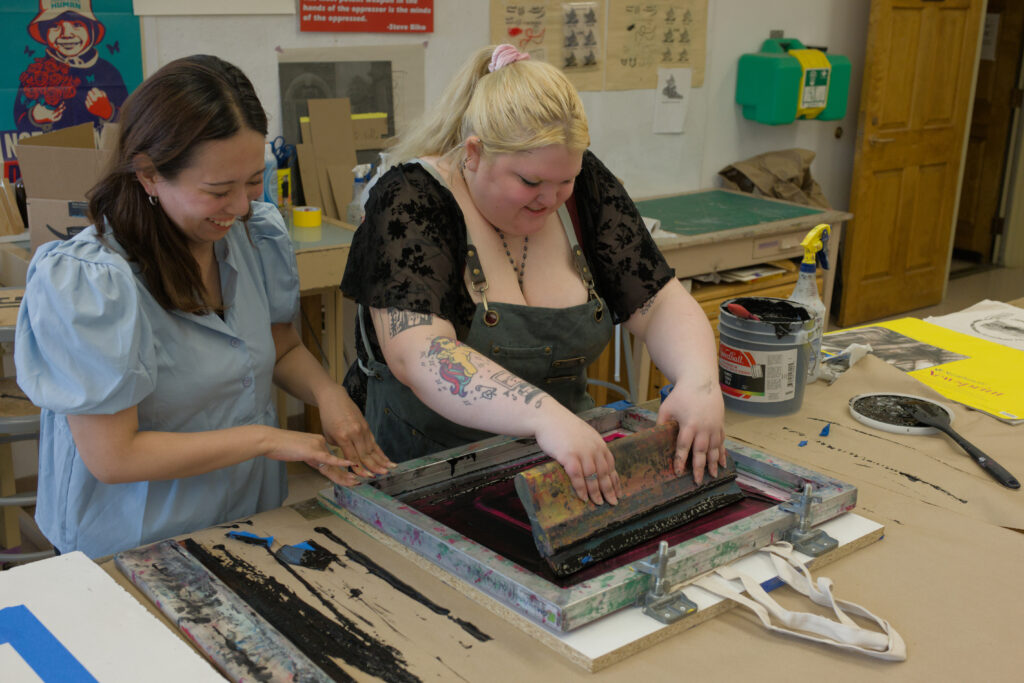
The Simpson Library exhibit profiles the first ever minorities to attend UMW. | Violet Ayers / The Weekly Ringer
by AYA OGAWA
Staff Writer
At a screen-printing demo on April 15 in Melchers Hall, students pressed ink through mesh screens onto tote bags. The transferred images featured two women who are deeply connected to Mary Washington’s past.
They were Mary Wong and Meechi Yokogawa, two of three figures featured in “Stories of Firsts: Asian and Asian American Students at Mary Washington,” as well as Marie “Bunny” King, at an upcoming exhibit at Simpson Library.
The student curator of the exhibition, MacKenzie Martin, a senior studio art major, worked on the project with Sarah Appleby, a university archivist at Simpson Library, and Kristen Moon, a UMW history and American studies professor.
“This kind of project was so different than anything I had done before. It was research-based and historical-based, and it was for something that was incredibly exciting to get involved in,” Martin said.
According to Appleby, Wong, who was born in Washington, D.C., enrolled at UMW—then Mary Washington College—in 1948 and graduated in 1952 with a bachelor’s degree in chemistry. She graduated in three years and was involved in campus life, including serving as class treasurer and participating in theater.
“From my perspective, the exhibit stands out in how it foregrounds individual histories and lived experiences. By emphasizing personal memories and archival records, it avoids stereotyping and presents each woman’s story with nuance,” said Suzie Kim, associate professor of art history and adviser for the project.
Wong’s story fills one full display case, while Yokogawa and King share another. Martin said Wong’s case is fuller partly because the team had more material to work with, including an oral history interview conducted by Moon.
“A bulk of this project was kind of formulated around an hour-long interview that Dr. Moon had with Mary Wong,” Martin said.
King, who immigrated from Shanghai and was at Mary Washington for a short period in the mid-to-late 1940s, represents the immigrant experience in the exhibit, with much of her story shaped by visa documents and immigration records.
Yokogawa, the first UMW student of Japanese ancestry, came from Tokyo and arrived in 1950 after being delayed by the Korean War. She was described in campus records as a strong student who joined several organizations before graduating in 1954.
“They are really the first students of color to attend Mary Washington, and they’re part of this almost sort of glimmer of possibility right during World War II and into the early 1950s that there’s something changing in the country, changing in Virginia, changing in Mary Washington, that potentially we will become more inclusive,” said Moon.
The exhibit itself developed over time, through conversations with Moon and Appleby that started after Moon came across Wong’s name while reviewing a 1950 census.
“We had been working to identify kind of the first Asian and Asian American students at Mary Washington, so that we could highlight them,” Appleby said.
Martin’s involvement in the exhibit occurred later, after approaching Appleby about working in the archives.
“[Martin] had expressed interest in doing an internship with the archives, and we thought that it would be really interesting to have somebody with an artistic background with a particular kind of approach to visual media to sort of interpret these stories and figure out a way to put together a really cool exhibit,” Appleby said.
In addition to the core team, some students were invited to contribute feedback during the planning process.
Lily Mizoe, a senior psychology major, said she was drawn to the project because of its focus on underrepresented histories.
“I think that it is important to recognize the history of minorities on our campus. I didn’t know anything about the history of Asian students at UMW, so I was very interested,” Mizoe said.
Mizoe said her perspective was welcomed during the planning meetings, even as someone not directly involved in the research.
“My perspective and opinions were welcomed and taken into consideration. I was glad to be able to bring an outside view from the project,” she said.
Mary Washington had originally been founded as a teaching college for white women and remained an all-white institution for many years, making these stories especially significant.
“It’s always, I think, worth telling the story of people whose stories don’t often get told, and in a predominantly white institution that’s typically racial and ethnic minorities,” said Appleby.
However, the exhibit also reflects two different stories about ethnic minorities: Wong’s Asian American experience and the immigrant experiences of King and Yokogawa.
“There’s really two stories that are being told here,” said Appleby. “There’s the Asian American experience, and then there’s the immigrant experience.”
The April 15 demo gave students a chance to engage with the project directly. Participants chose between two tote bag designs: one featuring Yokogawa and one featuring Wong standing in front of James Farmer Hall. For some students, the demo was also their first introduction to the exhibit.
Participants responded to the demo in different ways, depending on their familiarity with the exhibit and printmaking.
“I hadn’t even heard of the exhibit before this, so now I definitely want to go see it,” said Clarissa Igl, a junior philosophy and pre-law major.
Others were drawn in by the artistic process itself.
Stella Lemmond, a sophomore studio art major, attended because she already had some printmaking experience and wanted to see screen printing “on the big, professional level.”
“I think it’s relevant not only for the sake of being aware of our campus’ history, but I feel, as an Asian-American woman, that I owe something to these women who paved the way for me to be here at UMW,” said Madamba.
“It was wonderful to see students enthusiastic about the printing process as well as the subject matter, so it reinforced for me that we’re showcasing a topic that people genuinely want to know more about,” said Appleby while reflecting on the demo.
The exhibit reception and print unveiling will take place on April 24 at 2 p.m. on the third floor of the Hurley Convergence Center. The exhibit itself will be displayed on the second floor of Simpson Library and will remain up through the fall semester.