Lost in the laptop labyrinth: Why UMW students need to close the screen and claim the education they paid for
4 min read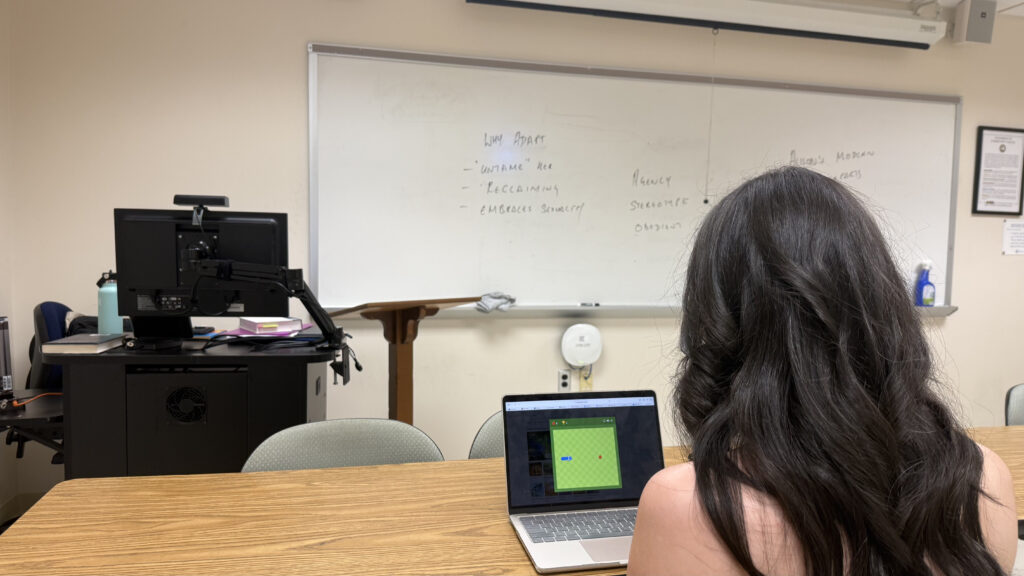
Students using their laptops too much in class worsens discussions and destroys the point of attendance. | Thomas Jackson, The Weekly Ringer
by TYLER BILLINGLSEY
Club Writer
Whether you’re in Combs, DuPont, Farmer, Seacobeck, or Jepson, if you choose to sit in the back of a class, you’re familiar with one visual: an endless night sky of bright laptop screens dotting the classroom ahead of you.
This itself presents no real problem, but the visual noise can be distracting. It’s convenient to take notes quickly and having notes for each class on a single device is indispensable for most students.
Any introvert familiar with the back row can tell you something else about every laptop screen they can see, with half of them flipping quickly between Google Docs and something else. Anything else. Block Blast, Google Snake, Messages, Discord, Outlook, Gmail. In the most egregious instances, I’ve sat behind students fully playing Minecraft in the middle of their lecture.
Using a laptop to play games during class is a flagrant and ridiculous misuse of technology. It’s easy to see the texting, emailing and other misuses just as condemnable and while they’re nothing to be praised, they’re much more of a societal sickness than a sign of blatant disrespect.
One day in class, I watched a girl a few rows ahead of me manage three text conversations and draft an email at the same time. With her messages pulled up in a smaller window, she rapidly clicked between contacts, waiting for the next message she could receive. Each message she received drew her further from the class at hand and the one she was actively paying for.
In her defense, she was not only coordinating multiple correspondences. She managed to squeeze in time for a few school-related activities, such as browsing the UMW Theatre webpage, looking at her major requirements and checking her school email. Ever the overachiever, she even fit in a few minutes to take notes.
Like the rest of her online activity, these notes were streamlined for efficiency and accuracy. She clicked back and forth from the online slides to her Google Docs and copied each word from the slides onto her document. To be safe, rather than copying it down on the sentence level, she broke it down into clauses before splitting her attention back to the online slides and the rest of her online life again.
Technology is now used in nearly every part of our lives, with constant access to screens becoming more and more common. Along with access to the World Wide Web, there is also constant access to all of our demands and distractions at once. This is why we see students engrossed in their laptops rather than paying attention. How could they focus when they’re in front of a portal to all of their work, social and academic obligations at once?
It seems only logical to multitask. If there’s downtime in class, you can easily keep up your relationships by sending a few texts. If it’s an easy class, why not focus on your work for another class? It logically seems the best way to get things done. However, students are not robots.
Learning consists of more than an empty Canvas Dashboard and students in class deserve to experience class rather than sit behind a screen, seemingly existing only in service of their to-do list.
Of course, all of this is easier said than done. For many of us, we’ve been operating this way since middle school, just using school-issued Chromebooks rather than our own devices, which host even more distractions. The goal of eliminating rapid tab-switching is not necessarily to maximize learning, but to allow yourself to exist without extra obstacles constantly vying for your attention.
Not focusing in class is not the end of the world. Everybody has a dull or easy class, one they know they can multitask in. Don’t. If your attention is fading and you feel tempted to do something else, anything else, there are a few things you can replace productivity-chasing behavior with.
You could always try doodling or drawing in your notebook. It’s a classic for a good reason. For those with poor art skills, drawing simple shapes and shading them in can be just as appealing.
You could start journaling in your class notebook. Write about your day. Or about how bored you are. Or why you hate that guy sitting a few rows next to you. Anything works. Bonus points if you look up and nod every few minutes so it looks like you’re just a very diligent note-taker.
Try counting. In your head or on paper. See how far you can go with it. If this gets boring, start counting by sevens. Counting by sevens is hard.
These are all decent places to start, but coming up with your own non-digital time-wasters would be even better. Make it fun. Make it your own. Your laptop still exists after class ends. Give yourself a moment to be human.
The exception to the rule is if you are in a fight with your friends or partner. In that case, I’d ask you to kindly tilt your screen towards me and turn your font size as high as it goes.