Universities boycotting Israel could face financial restrictions under new House bill
4 min read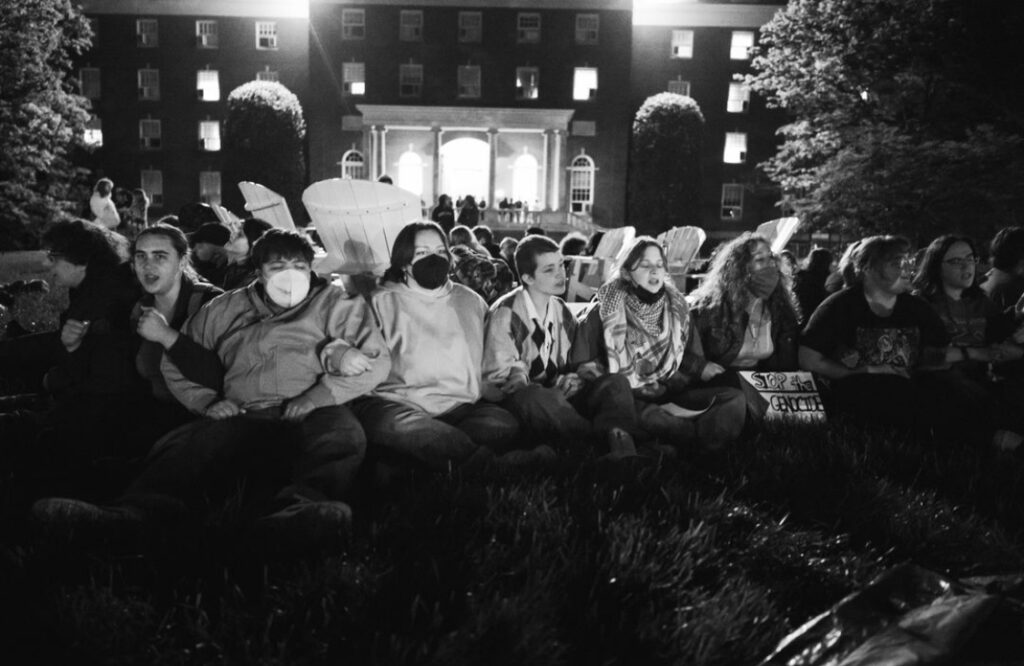
Students participated in a 2024 protest encampment on Jefferson Square. | Photo courtesy of Amirah Ahmed.
by LIAM HOWARD
Staff Writer
The House of Representatives passed legislation last week that could restrict certain federal funding for colleges and universities that participate in boycotts of Israel, raising questions about what the measure could mean for institutions like the University of Mary Washington.
The Protect Economic and Academic Freedom Act of 2026, or H.R. 4795, passed the House on Sept. 3. Introduced by Rep. Virginia Foxx (R-N.C.), the bill would require colleges participating in certain federal programs to refrain from commercial boycotts of Israel that are not based on legitimate business reasons. It would also require institutions receiving certain federal funding to treat academic programs involving Israel the same as those involving other foreign countries.
Supporters of the legislation argue that federal funding should not support universities that discriminate against Israeli institutions, businesses or students. According to a press release, House Education and Workforce Committee Chairman Tim Walberg, R-Mich., said following its passage that universities should not use taxpayer-funded programs to discriminate against Israelis.
“Our universities should not use taxpayer-funded federal programs to discriminate against Israeli students, faculty, institutions or businesses simply because they are Israeli,” Walberg said.
The legislation has also generated concerns over free expression and academic freedom, particularly as universities across the nation have become centers of debate and protest surrounding Israel’s war in Gaza.
At UMW, Associate Professor of Political Science and International Affairs Ranjit Singh said he believes universities have a particular responsibility to remain places where controversial political issues can be openly debated.
“My view is that if you cannot protest something in good conscience at a public university, then you can’t protest anywhere,” Singh said. “This is where we discuss a lot of stuff, right or wrong and you’re allowed to be wrong too at a university.”
Singh, who has lived and worked in Palestine, has previously participated in campus discussions surrounding the conflict. He expressed concern that government action involving universities and political expression could discourage some members of university communities from speaking openly.
He pointed particularly to younger faculty members who have not yet received tenure.
“Think of it from the perspective of, let’s say, you’re a newly hired faculty member, an assistant professor; you have to wait five years until you get tenure,” Singh said. “So it does intimidate younger faculty from speaking their minds. Or at least it has that ability, right? Because they’re not tenured yet. They don’t have job security.”
Debates surrounding Israel and Palestine are not new to UMW. In April 2024, a pro-Palestine protest and encampment took place in Jefferson Square. UMW permitted the protest to continue but prohibited the encampment, citing health and safety concerns and university policy. Twelve people, including nine students, were eventually arrested for trespassing after remaining in Jefferson Square following an order to leave.
Singh said he and a former student spoke on the steps of George Washington Hall the morning of the arrests and criticized the decision to arrest the protestors.
Singh connected the incident to UMW’s history with figures such as civil rights leader and former professor James Farmer and alumna Jean Donovan, both of whom are remembered for acting on their beliefs in the face of injustice.
“We are teaching all this in class, you know, like if you see injustice, don’t be quiet, act,” Singh said. “And we hold these people up as icons. Yet you’re arresting students who, in good conscience, nonviolently are saying, ‘I see something and I think it’s wrong.’”
Student activists have also called for UMW to take action related to Israel. Shane Maguire, co-chair of UMW’s chapter of the Young Democratic Socialists of America, said his responses reflected the chapter’s broader position, which opposes H.R. 4795 and supports UMW participating in boycott or divestment efforts involving Israel.
According to Maguire, the previously active UMW chapter of Students for Justine in Palestine advocated for the university to divest from Israel and organized protests calling on UMW to respond to the conflict.
UMW YDSA also believes the legislation could discourage student activism even though its restrictions focus on actions taken by universities rather than individual students.
“The passage of this bill would defang the student peace movement from one of its biggest tools to oppose genocide on college campuses,” Maguire said.
The chapter wants UMW to publicly oppose the legislation. Maguire said doing so would be consistent with the university’s previous efforts to facilitate discussion surrounding Israel and Palestine.
“If the university is serious about their prior stated commitment to facilitating discussion on this campus around Israel-Palestine, they should publicly and privately oppose this bill,” Maguire said.
UMW has previously identified free expression and dialogue as priorities in its response to the conflict. In a November 2023 message to the university community, UMW President Troy Paino said the university’s priorities included protecting free expression and diverse viewpoints while creating opportunities for education and dialogue.
Whether the newly passed House legislation will directly affect UMW remains unclear.
When asked for the university’s response to the bill and its potential implications for UMW, Amy Jessee, executive director of University Communications, declined to comment while the legislation remains under consideration.
“The legislation in question is still pending, so it’s too early for any comment,” Jessee said.
H.R. 4795 would still need to clear the Senate and be signed into law before taking effect. In the meantime, its House passage has renewed a debate over how universities should respond to calls for boycotts and divestment related to Israel and how far the federal government should go in attaching conditions to university funding.
For now, UMW has not taken a position on the pending legislation, while members of its campus community continue to debate what role universities should play in responding to the conflict and where to draw the line between institutional policy and political expression.