Palestinian-Israeli relations expert speaks at teach-in with UMW professors in discussion on ongoing conflicts in Gaza
3 min read
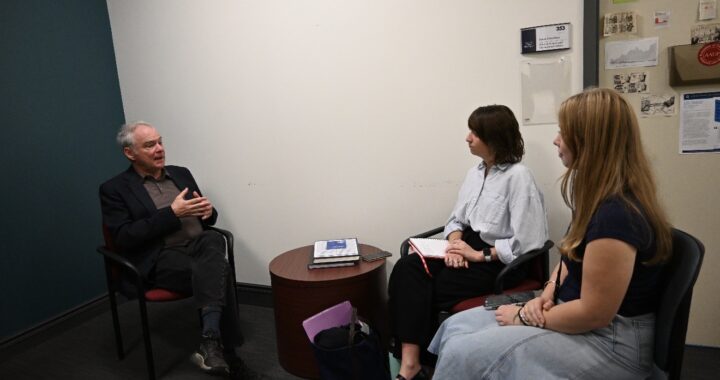
Students listen as teach-in speakers Nabil Al-Tikriti, Ranjit Singh and Khaled Elgindy discuss history of the region and the ongoing conflict occurring in Gaza. | Abbey Magnet, The Weekly Ringer
by MADELYN TUNNELL
Staff Writer
On Sept. 25, professors from the departments of political science and history hosted a teach-in to discuss the ongoing conflict in Gaza.
The teach-in was organized by Professor of Middle East History Nabil Al-Tikriti, Associate Professor of Middle East Politics Ranjit Singh and Khaled Elgindy, a senior fellow at the Middle East Institute, the director of the Institute’s Program on Palestine and Palestinian-Israeli Affairs and adjunct instructor of Arab studies at Georgetown University.
The event was held in the Digital Auditorium of the Hurley Convergence Center. By 7 p.m., about 80 students were gathered in their seats to hear from the speakers.
“The presenters did a fantastic job at getting the severity of the conflict across and were able to give context and important statistics to describe this conflict in a way people who may know nothing about it could digest,” said sophomore international affairs major Zoe Korejwo.
Al-Tikriti started by providing a historical overview of the ongoing conflicts that have taken place in the region from 1881 to the present. The talk then turned over to Elgindy, who focused on the events in Gaza before, during and after Oct. 7, 2023.
“A total of 310 Israelis were killed in the 15-year period before Oct. 7. Half of them, roughly, are soldiers who died in the various Gaza wars in 2009, 2012 and 2014,” Elgindy said. “In that same 15-year period, from 2008 until Oct. 6, 2023, more than 20 times as many Palestinians were killed.”
Elgindy noted that Oct. 7, 2023, was the deadliest day in Israel’s history.
“You remember that 310 Israelis were killed in 15 years? Well, four times as many were killed in a single day,” Elgindy said. “It’s a collective trauma that all Israelis felt.”
Furthermore, Elgindy explained, “For Palestinians, it has been the deadliest single moment in the history of the Palestinian people.”
A PowerPoint slide presented during the teach-in stated that the total death toll for Palestinians was 41,000 people.
“Gaza has been annihilated, in a non-hyperbolic sense, and in the literal sense, the scale of death is unprecedented,” Elgindy said. “All of Gaza’s universities have been destroyed. All 14 of them. Most of Gaza’s hospitals. Most of Gaza’s very limited agricultural area has been destroyed.”
Singh ended the teach-in with his personal experiences from his time studying at the University of Jordan.
“The first time I started learning firsthand about what was happening in Israel and the Palestinian territory zones was in 1991 when I was a student at the University of Jordan,” Singh said.
“It’s very easy to get lost in the weeds on issues like this that have such a long history and so many different kinds of competing interests and viewpoints,” Singh continued. “You have to ask yourself, ‘What principles do I stand for? What are my values? Is it law? Is it justice? Is it human rights? Is it nonviolent action?’ You know yourself in that sense. And I think that to do that is extraordinarily liberating.”
The teach-in ended with an opportunity for audience members to ask questions. Korejwo left feeling like they had a greater knowledge of the topic.
“I thought it was a very well-done presentation. All of the presenters were obviously very well versed in the topic as they had done research for years and all seemed to have personal experiences with the subject,” said Korejwo.
Singh agrees that the teach-in was productive.
“It was very informative and polite, but I think people came there because they wanted to learn something,” he said. “They wanted to learn perspectives.”