Raymond Arsenault gives presentation on life of John Lewis
3 min read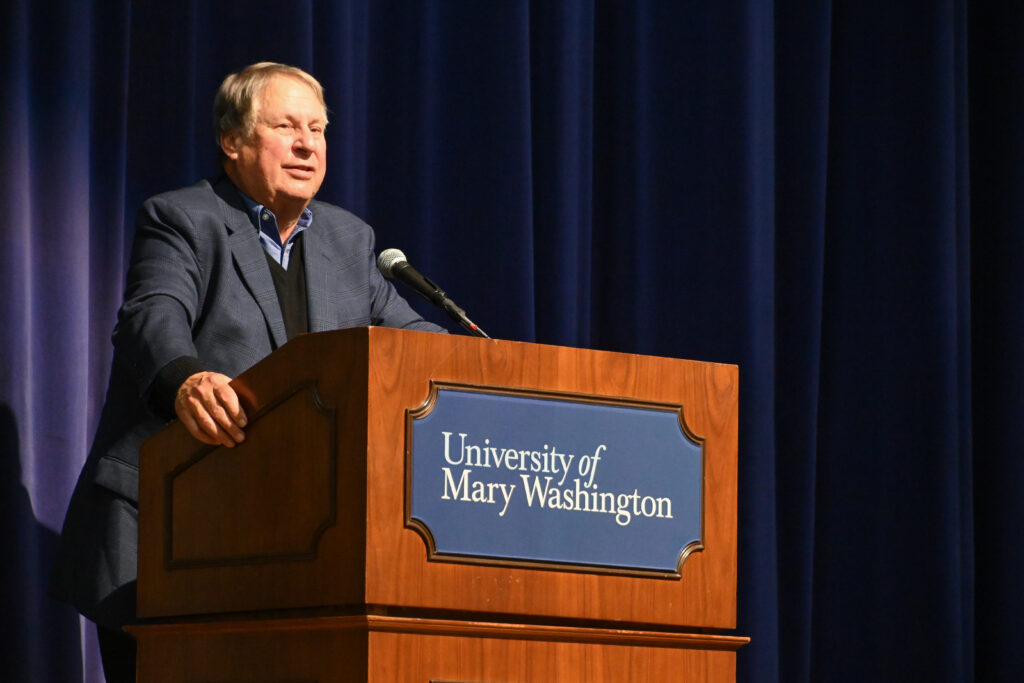
Raymond Arsenault has spoken for the UMW Great Lives Matter Series in the past, highlighting civil rights and social justice activists throughout history. | Abbey Magnet, The Weekly Ringer
by KY HUYNH
Associate Editor
On Tuesday evening, the UMW Great Lives Lecture Series welcomed back author Raymond Arsenault, who presented his book on civil rights activist and politician John Lewis. In the book titled “John Lewis: in Search of Beloved Community,” Arsenault recalls Lewis’s work toward equality and inclusion.
“This one is really special to me,” said Aresenault. “I can say without any doubt that he was the single most extraordinary person that I had the privilege of knowing in a lifetime.”
Director of UMW Great Lives Lecture Series and Professor Emeritus of History William Crawley highlighted Aresenault’s past lectures on leading figures and events in the civil rights movement, this being his fourth appearance.
“Professor Arsenault seemed an ideal choice to speak on the exceptional career of the late John Lewis,” said Crawley. “His impact on the series has been notable for bringing a strong focus on civil rights and social justice through the lives of the topics he has covered.”
In 1986, Lewis was elected to Congress and served for 17 terms. Lewis transformed Congress into a motor for social justice and change during his tenure there, according to Arsenault.
“He was totally committed to the philosophy of nonviolence,” said Aresenault. “Which is not an easy thing to do. I mean you can adopt it as a strategy or as a tactic but to actually have it dominate your life and to live up to that is, I think is quite extraordinary.”
Aresenault has spent his life around civil rights leaders and activists, and he expressed how he wanted to live up the same way that Lewis did.
“He would often say that the proof of putting and being committed to nonviolence is that somehow you have to bring yourself to a point where you can love your enemies as much as you love your friends,” said Aresenault.
Arsenault recounts the story of when American activist James Lawson started a nonviolent workshop teaching Gandhism in the fall of 1959. Lawson began holding workshops every Tuesday night, teaching not only nonviolence as a strategy or a tactic but as a way of life.
“He trained many of the people who would become the leaders of the movement over the next decade and John Lewis was one of them,” he said.
In 1963, Lewis gave a speech at a march that called for mass nonviolent movement across the south. However, some found his speech to be too extreme, and despite his passion, Lewis decided to tone it down. Aresenault noted that Lewis did this because he wanted to continue advancing civil rights without setting the movement back.
“He once said ‘I spend a lot of time giving speeches and writing things, but I’m not really a man of words, I’m a man of action. I want to see ideas turn into action,’” said Aresenault. “And he never forgot that.”
He continued, “Even though he was a quiet, soft spoken, a shy person, he has fire in himself when it came to freedom and social justice.”
Aresenault describes Lewis as someone who “always seemed to be able to do the right thing,” he said.
Allie Schwartz, a sophomore political science and English double major, has admired Lewis’s work in civil rights and as a politician.
“He worked tirelessly his entire life to create a more just and equal country for everyone, which is a sentiment I think everyone should appreciate,” she said. “I’m glad UMW is highlighting his work through the Great Lives Lecture Series.”
Crawley shared his thoughts on Aresenault’s contribution to Lewis’s legacy not only from his personal connection with him but also from research and interviews for the memoir.
“Both the book and the talk leave no doubt that Arsenault has enormous admiration for the Black leader’s contributions to American life, but also for his personal warmth and humanity,” he said. “Despite that personal connection, Arsenault’s approach is not worshipful, though it is certainly sympathetic.”