Regalia costs overshadow graduating students’ celebrations
3 min read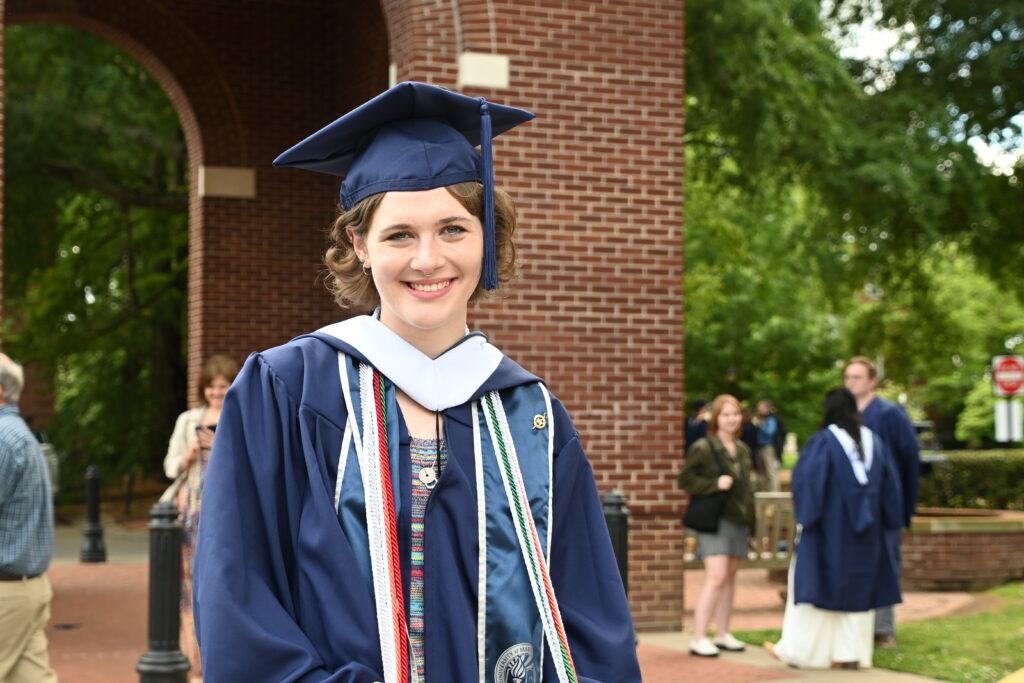
All regalia, including caps, cords and gowns, must be bought from the UMW bookstore. | Abbey Magnet, The Weekly Ringer
by ELLA CORDLE
Staff Writer
Every spring, UMW students prepare for graduation by purchasing required commencement regalia, adhering to hundreds of years of academic tradition. Students collect cords, decorate their caps and take graduation photos in their gowns.
However, the excitement surrounding the ceremony is routinely accompanied by discontent from some graduates because of the prices of required garb. This spring, the cost of a bachelor’s degree ensemble is $89.96 plus tax. This marks a price increase of $13.98 from 2024 and $31.98 from 2023.
“The caps and gowns are really expensive, which is a bit obnoxious considering what they’re made out of and that they’re used one time,” said sophomore geography major Sarala Kennedy.
UMW has used Oak Hall, a Virginia-based company, as its regalia provider for several years. The company produces its regalia locally and highlights its sustainability efforts, saying on its website, “The Class of 2025 will wear regalia made from 100% recycled plastic bottles. Each gown produced diverts 25 plastic bottles from landfills and turns them into GreenWeaver® regalia.”
Director of Community Events Ali Gauch Hieber said that the reason for the jump in prices is not coming from UMW, but Oak Hall, citing “inflation and the costs of the materials” as the source of the issue.
“When the price went up, we completed a cost comparison to make sure it was still one of our best options,” Hieber said. “Other vendors have comparable prices but may not be as reliable for shipping and delivery.”
Alex Thomas, a senior English major, pointed out that not everyone is interested in holding onto regalia after graduation.
“I don’t care to keep them. They’re just going to take up space in my closet,” Thomas said. “I think enough people, if given the option to rent or buy, would rent.”
Kennedy suggested a different idea about making regalia more affordable for students:
“I don’t think that it should be something that each senior has to purchase themselves, at least not at that price point,” Kennedy said. “It should be covered in activity fees that we already pay, rather than being an additional thing that each person has to go out and buy.”
According to the UMW Undergraduate Estimated COA 2025-26, all students pay $5,900 every year in auxiliary fees, which consists of costs like the health center and other student resources.
Kennedy believes that even if students were paying the same amount for the regalia, the convenience of paying for it in the cost of attendance would improve senior’s attitudes towards the fee.
“It wouldn’t be as stressful, and it wouldn’t be like a talking point anymore on campus,” Kennedy said.
Layla McGovern, a senior English and communication and digital studies double major, echoed the sentiment.
“You have to transfer money before you go into the bookstore to make sure you have enough in your checking account to buy your cap and gown, because you know you’re going to leave at least $100 short,” McGovern said.
Hieber said that UMW is interested in hearing further student feedback on this matter for future consideration.
“We appreciate student feedback on possible options for renting robes or donating used robes to the next class,” she said. “If there’s interest this year, we could work with Gwen Hale Resource Center to make a donation box available.”