New chain fence blocking popular desire path elicits strong response from students
4 min read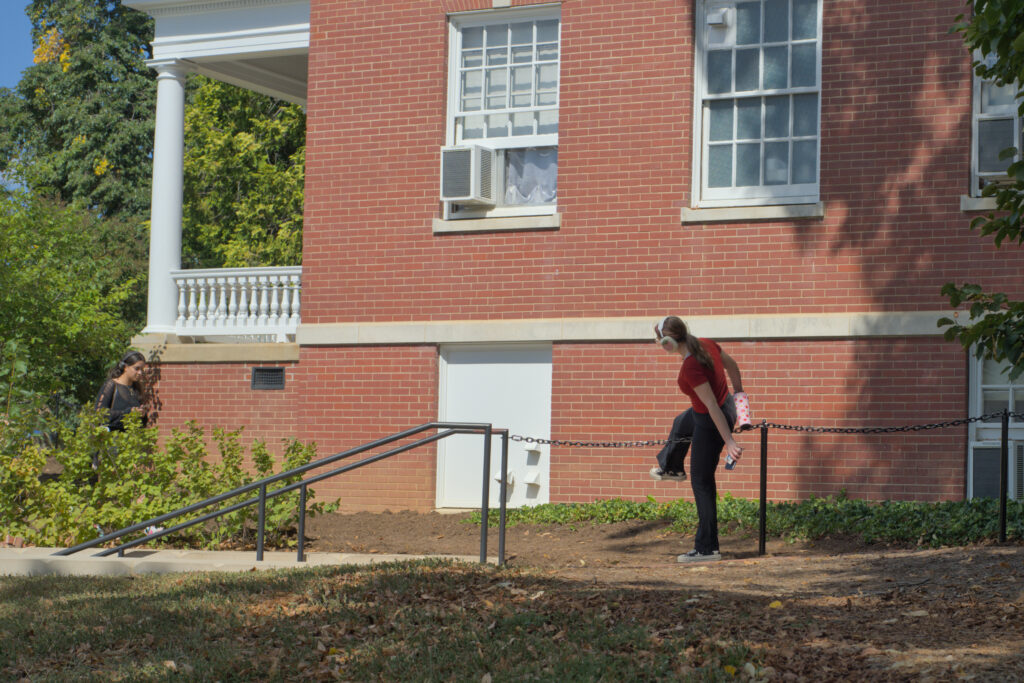
Students continue to use the desire path despite the new fence. | Violet Ayers, The Weekly Ringer
by EMMA KINGKEO and MEAGHAN VAN DYKE
Associate Editor and News Editor
On the morning of Sept. 4, students were greeted with a chain-link fence that spanned the distance between Custis Hall and the University Center, blocking a popular desire path that connects to campus walk. According to Assistant Vice President of Facilities Brian Gorham, this was done due to “an ongoing safety concern.” The blockage elicited a largely negative response from students, both on campus and online.
“I think this is more subtle for students who are not familiar with the path, but more overt for me that this is one of the ways the university prioritizes looks over student experience,” said senior sociology major Alexis Pineda-Bautista.
Desire paths, or a faster path used by pedestrians over a more formal, planned route such as a sidewalk, are popular ways for many students at UMW to travel in between classes.
The distance saved from this path made a difference to students like junior English major Sarah Moon, who had to walk the length of the campus to get from one class to another in a short amount of time.
“I know for my freshman year, I had a class all the way in the HCC and I had 10 minutes to get from there back to Combs, so that path usually made it easier for me,” said Moon. “In accessibility terms, it’s a lot easier to get from one place to another.”
The response from students did not go unnoticed by administrators.
On Sept. 5, an apology was issued from Gorham to the President and Vice President of the Student Government Association for the lack of communication and impact on students’ campus experience, which was then posted on the SGA Instagram.
“We are sorry that we failed to connect with student leaders first about this issue, and we very much understand your valid concerns about communication and inclusion,” Gorham wrote in the email.
SGA confirmed in the caption of the post that SGA President Amira Said, a senior environmental sustainability and policy major, met with Gorham to address students’ responses to the fence’s construction, and said that an effort will be made to establish the inclusion of student voices in the future.
“We are looking forward to collaborating with University Facilities and the Division of Student Affairs to ensure that student perspectives are considered as both safety concerns and pedestrian traffic are addressed in the area moving forward,” the caption said.
Gorham also confirmed that there have been issues with the fence chain being ignored and vandalized. However, the fence’s construction presented more safety issues than it solved, according to Pineda-Bautista, as boulders were placed on the other side of the fence to block off a safer part of the desire path.
Pineda-Bautista also went on to say that the fence did not accomplish its original goal of deterring students from the path. Some students have been observed stepping over the chain or walking around it closer to the edge, further defeating the purpose of the initial block.
“I saw that, and I was just like, ‘Are you serious?’ Because, yeah, maybe it deters some people, but it’s not enough to make me, like, turn around and take the stairs,” they said.
The gaps in communication that have led to discontent among the campus community are acknowledged by Vice President of Student Affairs Mike Walsh.
“We truly understand the very valid frustrations we caused by not working with students ahead of time to discuss the safety issues with this path and our need to find a solution due to those safety issues,” he said.
While the specific safety concerns over the path were not confirmed, the desire path runs along the top of a brick stationary wall facing the UC drop-off loop, where if a student were to fall over the edge, the impact could cause personal injury. For students like Moon, installing a barrier next to the path could provide a compromise for students and faculty concerned about safety.
“When I walk the ledge, sometimes I get a little nervous,” Moon said. “But it’s kind of second nature for most students I feel like.”
While many other desire paths are frequented around campus by students, Gorham confirmed that Facilities has no plans to close off any others at this time.
“Facilities is not aware of other paths that pose a similar safety concern,” said Gorham. “We are working through feedback from SGA and conversations continue as the landscaping work is in progress.”
Given the central location of the path, and its popularity among students and staff, some felt that the university should have known better than to rope it off without warning.
“I still respect their authority and understand that they want people to be safe, but I don’t think you needed to ‘connect with the students’ to realize how often that path was used—new mulch gets put down and is flattened within a day or two,” said Megan Gumaer, a junior historic preservation major. “It has made me feel that they might be slightly disconnected from the way in which students use the campus outside of organized group or school activities.”
Gumaer continued, “I’d argue that making this unofficial path into an official one would make getting to the main floor of the UC or to the center of campus more accessible, as well as cut some of the time it takes to get from Combs to the center of campus.”
As some in the community express frustration with UMW staff and faculty for the decision, Walsh reminds students that the miscommunication was not intentional.
“While missteps might happen, I hope that students can understand that we are people too, who make mistakes. And most importantly, that we are people here for students and whatever work we do is in service to them,” he said.