Mary Wash dining is unhealthy and expensive
3 min read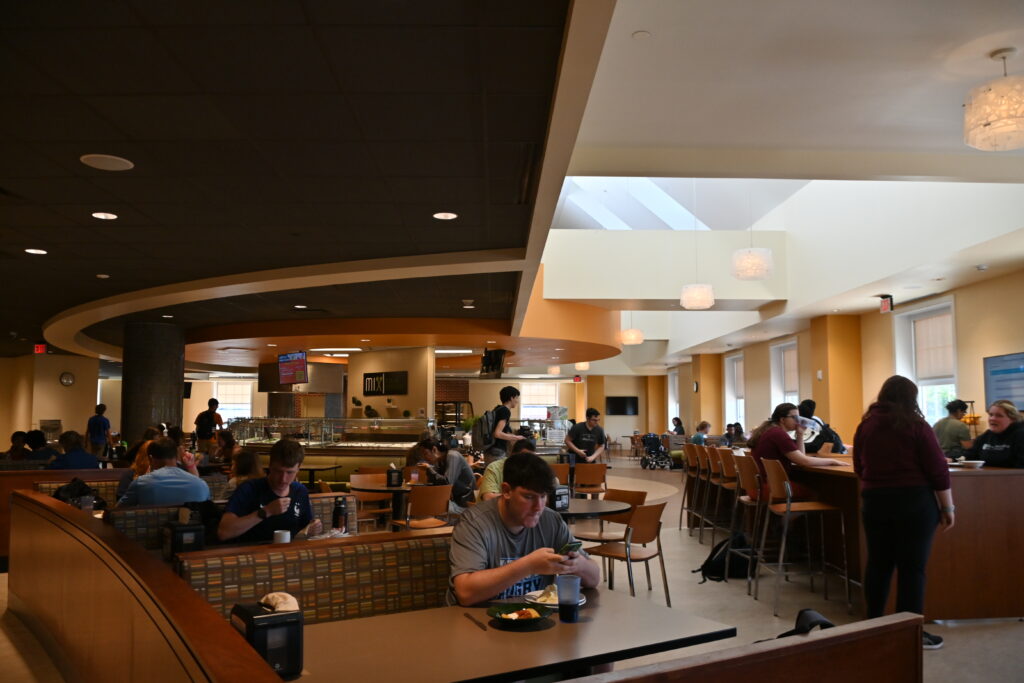
Students don’t enjoy eating at the CRUC dining hall due to a lack of variety and healthy options. They often resort to expensive retail dining instead. | Photo courtesy of Abbey Magnet
by AMAL SURANI
Staff Writer
Out of the thousands of dollars my parents spend each year for my college education, $2,000 goes to a meal plan that leaves me with $200 in retail flex and 225 meal swipes, which don’t carry over to the next semester. The meal swipes enable me to access the dining hall at the Top of the Cedric Rucker University Center, and I look to retail dining, like Panera and New York Pizza and Deli, to spend my flex dollars. Despite these dining options, UMW fails to provide students with a diversity of healthy meals for the price students pay.
The dining hall is a hotspot for students who want to get a quick meal before their classes, however, the options get old quickly, especially those considered healthy.
“The CRUC breakfasts are very greasy and oily,” said Jocelyn Borges, a sophomore math and secondary education major. “So it makes it very hard to get a nutritious breakfast and not feel sick when I go to class.”
Instead, she spends her flex dollars at the Simply-To-Go market, stocking up on food items, but not getting a full, hot meal like she would at the dining hall.
“I stock up on coffees or muffins from the little convenience store,” Borges said. “But I don’t think that’s the most nutritious thing.”
If I could, I’d also opt for items at Simply To-Go for a healthy option, but I’ve already spent over 50% of my flex dollars, and we’re less than halfway through the semester. Sophomore conservation biology major Megan Perkins is in a similar predicament.
“I’ve already gone through half of mine and we’re not even halfway through the semester,” she said. “I know people who are already out of flex and meal swipes.”
To help ease this issue, UMW should expand the healthy options at the Top of the CRUC. Currently, students looking for a healthy fix have the salad bar and Simple Serving, but these get old quickly. Simple Serving has rotating options, but the food is often bland, and the salad bar offers the same items every day.
The other stations available primarily feature overly watery pasta and raw, doughy pizza. The burgers are popular, which means there’s usually a long line to wait for them, and none of these options are particularly healthy.
Expanding dining options would not only encourage students to choose healthy meals but it would also alleviate financial stress associated with flex dollars and meal swipe limitations.
“I feel like that’s a waste of my money and my parents’ money that I need to get my food elsewhere because I just can’t stomach a meal,” Borges said.
Junior cybersecurity major Addy Fincke has a meal plan of $300 of flex and 150 meal swipes and tends to choose retail dining due to dietary restrictions, usually turning to For Five for convenience. However, their menu is still limited, and the items are expensive.
”They’re seven dollar sandwiches, which isn’t great, considering it’s just dining hall food repackaged,” she said.
When looking for a healthy option, I like Panera’s menu, but the prices make it hard to justify.
“I do not need a $12 salad,” Fincke said.
Shying away from expensive options, I tend to skip meals or resort to eating less than what I should. This seems to be a bigger issue around campus, with students eating unhealthy food, or just not eating at all.
“Today, my dinner was made out of candy I got from NSP and my breakfast was a bag of chips,” said sophomore music major Ian Frazier. “But I had a normal lunch. It was nice.”
Perhaps, if UMW dedicated resources towards creating a rotating healthy menu at the Top of the CRUC, students would not resort to vending machine dinners.