UMW employs goats to landscape campus
4 min read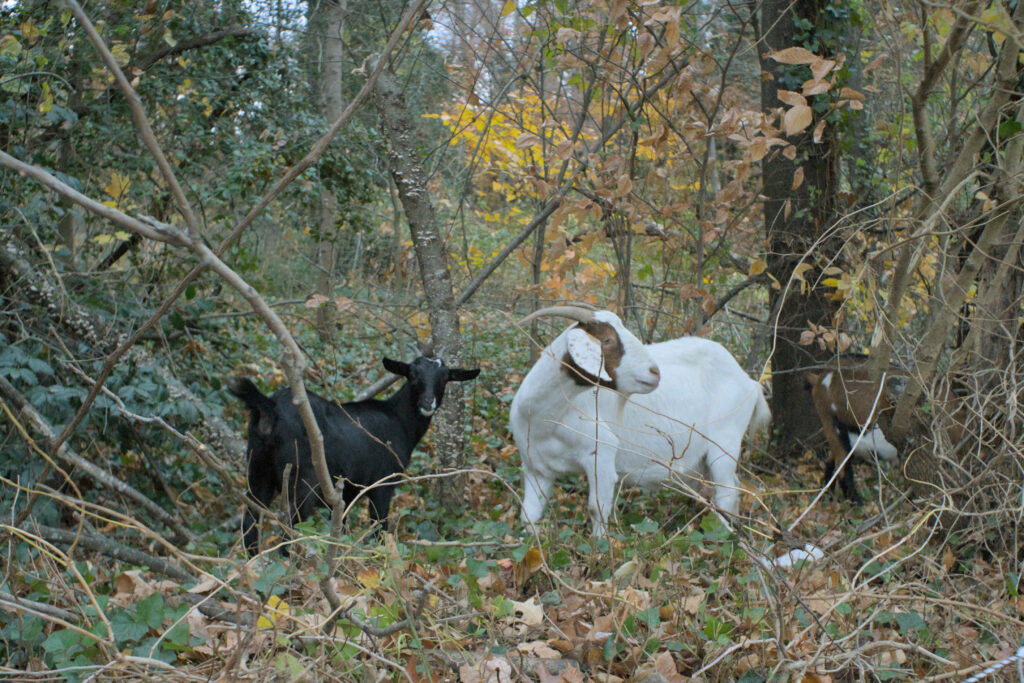
UMW landscaping is bringing goats on campus to control the invasive plant species near Sunken Road starting Nov. 12. | Violet Ayers, The Weekly Ringer
by ELLA CORDLE
Opinion Editor
Early this month, a herd of goats was invited to the University of Mary Washington campus to remove overgrowth and invasive species along the Sunken Road side of campus.
The dozen goats come from The Good Steward Farm in a partnership facilitated by Holly Chichester-Morby, director of the Landscape and Grounds department at UMW.
“I’ve had goats on my radar for over a decade and knew I would eventually get the opportunity to bring them onto campus to help us out,” Chichester-Morby said. “These kids are here to help UMW Landscape and Grounds get a head start on the weed trees and invasive species, like English ivy, non-native honeysuckle and other overgrowth in the woods along Sunken Road.”
Carly Brown, a representative for The Good Steward Farm, expressed the company’s excitement for the partnership.
“We feel exceptionally positive and grateful for the opportunity to partner with UMW on a sustainable goat landscaping initiative,” she said. “It’s so important that young folks learn about different ways to embrace agriculture and sustainability, especially at the university level where problem solving and innovative ways of thinking are the order of the day.”
She continued, “It’s a symbiotic relationship—the goats get a great selection of things to munch on all winter and we get much-needed help with clearing the woods.”
Many students have echoed the excitement of the Landscape and Grounds Department.
“I find the goats to be a delight,” said Jessi LaBruno, a junior biomedical sciences major. “Several of my friends and I have raved about their use. Not only do we love watching the goats, but we love how environmentally friendly this is. Using goats instead of fossil fuel-burning equipment is such a plus.”
Other students agreed that the new initiative was a positive addition to the campus.
“I think the goats are fun. I’ve only heard positive things said about them throughout campus,” said Rae Mears, a junior biology and psychology double major. “It also makes me happy that UMW is utilizing mutually beneficial and natural ways to get rid of invasive species.”
A few students and staff members have formed attachments to the new visitors, especially a goat named Joanie.
“She is extra special—she has an extra toe on her back leg—it has its own little hoof that needs trimming,” said Chichester-Morby.
A message forwarded from Landscape and Grounds by Executive Director of University Communications Amy Jessee informed students of the goats’ presence on campus and mentioned that these goats have done similar work around the City of Fredericksburg already. The message strongly cautioned students to leave the goats alone.
“These are working goats and should not be fed or touched,” the email read. “Viewing areas will be available around the perimeter of their grazing area, which is secured by electric fencing. Please do not come into contact with the fence or the goats.”
The lack of noise and inconvenience from traditional landscaping methods is also seen as a bonus for students.
“I do like the idea of goat landscaping as a whole. It’s way better than the loud tools they would be using otherwise and it seems like students are really enjoying seeing them,” said Celia Golden, a senior communication and digital Studies and religious studies double major.
Chichester-Morby said that the goats will remain on campus for a while if everything goes to plan.
“Goatscaping is a great option for us,” she said. “I’m hoping to keep goats in the mix through the winter – we have a few decades of overgrowth to offer along that side of campus as a goat buffet. I’m hopeful that this partnership can continue for years to come.”
Goat landscaping, also known as “Goatscaping”, has grown in popularity over the last few years. The process is exactly what it sounds like—goats are hired to graze on a particular area of land where they consume overgrown or unwanted vegetation.
Hiring goats is more cost-effective than renting heavy equipment and paying for people to operate it. Goats can also work in a variety of unstable terrains that are difficult to navigate with machinery, such as the steep, hilly woods on Sunken Road.
Using goats can often be an alternative to toxic herbicides, as well. Unlike many livestock animals, goats do not produce large amounts of methane. Goats can also consume plants that are problematic to humans, such as poison ivy or invasive species. The digestive process of goats sterilizes seeds and other plant matter, which prevents invasive plants from regrowing.