Campus rec fields should be open to all students
4 min read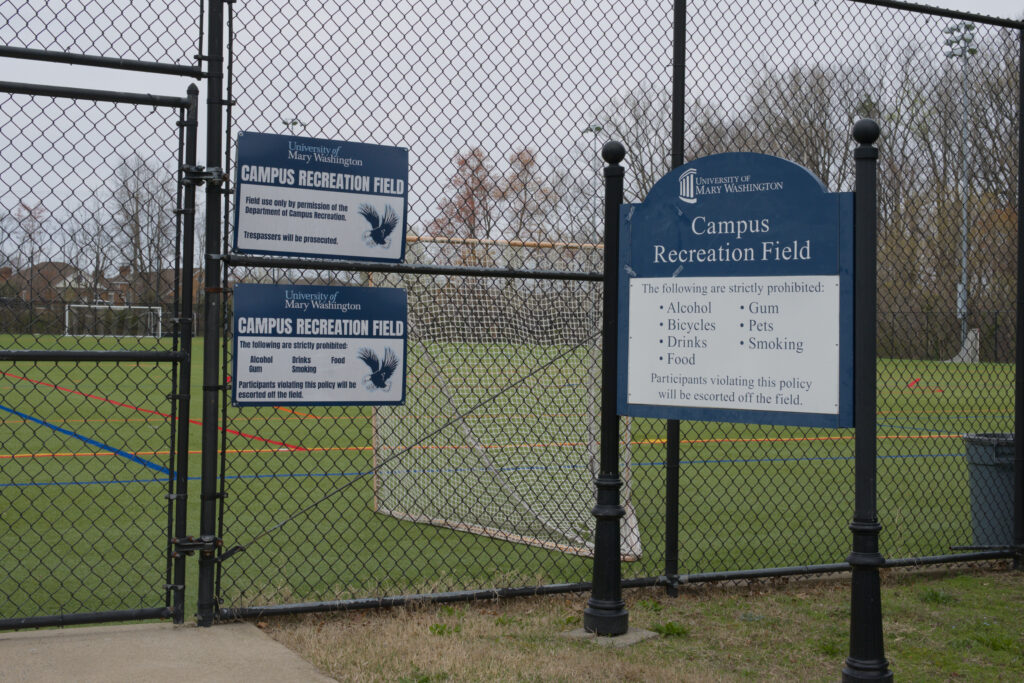
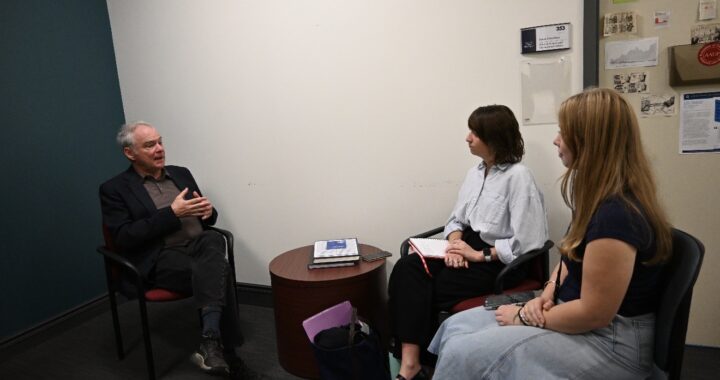
Many non-athlete students would like to use the rec fields for casual sports, but are not allowed to. | Violet Ayers, The Weekly Ringer
by CLAIRE LEATHEM
Staff Writer
Every time I walk down campus on a nice sunny day, I’m sure to see a group throwing a frisbee, some friends kicking around a soccer ball and others basking in the warmth. There just always seems to be some sort of action happening on Ball Circle or Jefferson Square when the weather gets nice. This makes it even harder to understand why our campus recreational fields are closed for non-athlete students.
With the kind of demand witnessed for a spot on Ball Circle in the spring, students would surely make use of open hours in the field, and it would greatly benefit student life here at UMW. Casual sports are a great way to socialize and get some exercise that can relieve the stress of an average college student’s workload.
“Getting away from the constant stress of homework to go out and kick a soccer ball around with my friends is great,” said sophomore elementary education major Emily Ohlinger. “However, sometimes Ball Circle gets too muddy, and it’d be nice to have access to the turf field.”
A regular frisbee player on Ball Circle, sophomore biochemistry major Duncan Sanders, said that the constant closure of Ball Circle and Jefferson Square for maintenance can sometimes be inconvenient for casual sports.
“I understand the school’s concern with safety by leaving the gate unlocked,” he said. “However, I also think that with frequent closures to Ball Circle or Jefferson Square due to maintenance, it can sometimes leave students feeling trapped inside.”
Club teams also have their own struggles with the strict rules of the recreational field.
The President of club football, Landon Garboury, a junior business administration major, gave insight, saying that the coordination of unlocking the field makes things confusing.
“The fields being locked requires excessive tracking of who has what key and coordination that maybe isn’t really necessary,” he said.
Senior business administration major Dillan Shiflett said it also causes limited practice time as a player on club football. Shiflett mentioned that having to keep track of who has the key and having to wait for the president to get it causes team members to have to wait outside during valuable practice time.
“The fields being locked causes unnecessary delays [in] our practice because we have to wait for leadership to retrieve the keys and come unlock them,” he said.
I reached out to the Associate Director of the UMW Department of Campus Recreation, Arnaud Mensah-Etsi, to gain a better understanding of the reasoning behind locking the gate.
“The gate to the field remains locked except during scheduled club sport practice hours or games in order to properly manage access to the facility and preserve the quality of the playing surface,” Mensah-Etsi said. He went on to describe that a concern is if there is too much activity on the field, then it might cause damage to the turf.
“It reduces unnecessary wear and tear on the turf and ensures the field remains in safe and playable conditions for scheduled activities,” he said.
Playing sports with friends is very important to a lot of the student body here at UMW, and it should be deemed as necessary to provide students with a safe, level surface, unlike Ball Circle, to play on. What’s the point of preserving a field when a majority of the student body can’t use it?
Ryan Houck, a sophomore geography major on the club soccer team, agreed, saying that the field is meant to be played on by everyone.
“Students aren’t going to destroy the field just by running around playing a sport on it,” he said. “Turf is meant to be played on.”
The turf field is also well taken care of. If any harm were to happen to the turf, it would be fixed, as Mensah-Etsi established that there is a maintenance contract.
“We have a contract with a local turf management company that performs monthly grooming and maintenance to ensure the field remains in safe and optimal playing condition,” said Mensah-Etsi.
Mensah-Etsi said the other main reason for prohibiting students from using the field is to regulate who is using the field.
“Limiting usage to scheduled club sport practices allows staff to better monitor participation, maintain accountability, and ensure that the facility remains in good condition for all users throughout the academic year,” he said.
While this is very understandable, given that the school doesn’t want people not associated with UMW to use their field, it does seem excessive to exclude all students except for club teams.
This is a concern that can definitely be worked around in favor of both sides. Houck believes that locking it behind an EagleOne card could be a solution to this problem.
“Students could have a way to scan in using their EagleOnes during certain times of the day,” he said. “If that is too difficult, then maybe there could just be open hours during the afternoons of some days.”
It’s not right to lock down the recreational field during all hours except for practice times. The field is one of the campus amenities offered to the paying students of this university.
The total auxiliary comprehensive fee for a full-time undergraduate student from 2025 to 2026 came out to be $5,958.
$550 of that goes to Auxiliary Services Administration, which provides funds to pay the people keeping track of the upkeep of student facilities.
On top of that, $793 goes to recreation, and $550 goes to Auxiliary Facilities.
Opening the field to not just club teams, but all paying students is a discussion worth having.
It would greatly benefit students by granting them a place for physical, outdoor activities. This can definitely be done with rewritten restrictions that maintain the structure of who is using the field, while not completely locking it down.