Mary Washington’s PAC deserves more support
5 min read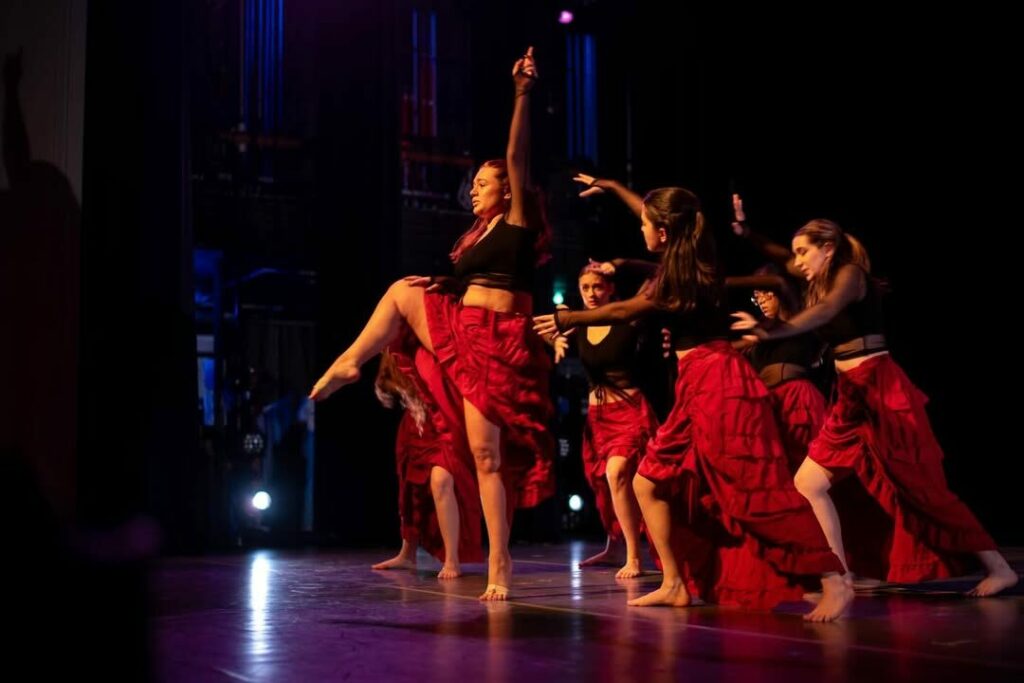
UMW’s Performing Arts Company is small, independent and relies upon student engagement and event attendance. | @umwpac, Instagram
by SIERRA MCKINLEY
Staff Writer
At the University of Mary Washington, performing arts are a visible and celebrated part of campus life. Mainstage theatre productions often take center stage, backed by institutional support, long marketing timelines and built-in recognition. But just a few steps away from that spotlight is a student-run organization doing equally ambitious work with far fewer resources: the Performing Arts Company (PAC). Despite its size, talent and commitment, PAC exists in a space where passion makes up for what institutional support lacks—and that imbalance deserves attention.
PAC is not just another campus club. It is a full-scale production company run entirely by students, producing multiple shows each semester. PAC is a dance company that allows students to choreograph different styles of dances that get to be showcased in both their small show and big show each semester at UMW. There is also UMW staff that choreographs as well as alumni that used to be in the company.
As senior historic preservation and environmental geology double major, Grace Hannah Buck, outreach officer and choreographer, explains that PAC is different because of the intricate production.
“PAC is different mainly because we have our own shows with more intricate production, like professional lighting each semester leads up to our Big Show, where practically everything we’ve worked on during the past few months culminates,” she said.
These performances are not casual showcases—they are carefully constructed productions that require choreography, costuming, lighting design and stage management.
Still, unlike university-backed theatre, PAC operates without direct institutional funding.
“We are student-funded, so all of our funding comes from dues, tickets to our shows, and any fundraising we do,” Buck said.
Rising costs of production equipment only add to the challenge, Buck said.
“The prices of items like costumes have increased exponentially in the past few years, but we make do and work within our means.”
This financial reality forces PAC members to take on roles that go far beyond performing. Mollie Moomaw, a senior elementary education major and president of PAC, emphasizes the scale of responsibility.
“We create all of our dances, show order, costume orders, etc. by ourselves […] we are figuring out each show step-by-step while also balancing being students,” said Moomaw.
Unlike larger theatre productions that rely on experienced professional staff and structured systems, PAC students are learning everything in real time.
That learning curve, however, is part of what makes PAC so unique. Junior psychology major Cameron Gittings, publicity officer, highlights how this structure fosters creativity.
“Students are very creative and have a lot that they want to express. We get a wide variety of dances and stories that are being told each semester. You never know what to expect,” said Gittings.
PAC’s student-led nature allows for experimentation and diverse artistic voices, something that more formal productions may struggle to achieve.
Yet, while creativity thrives internally, external visibility remains a challenge. All three interviewees point to the same issue: PAC does not receive the same level of attention as mainstage theatre.
“Our publicity is fairly limited to what we are able to push out ourselves,” Buck said. “The theatre productions are […] an ingrained part of the university’s public image.”
Gittings echoes this, noting that theatre productions have extra help compared to PAC.
“The theatre productions have a greater ability to market their shows, and they run much longer, so there’s a lot more opportunity for people to see them,” said Gittings.
This disparity in visibility has real consequences. Audience attendance is not just about recognition—it directly impacts PAC’s ability to function.
“Without the audience, we would just be about fifty students on a stage in costumes, doing what we love,” Buck said. “With an audience, we get to share our passion and enrich people’s lives.”
Ticket sales and turnout are essential not only for morale but also for funding future productions.
Despite these challenges, PAC continues to draw strong support from those who are aware of it.
“We tend to have a lot of students, families, and staff attend,” Moomaw said.
Gittings adds, “We get a really good number of people that come to our shows.”
The issue, then, is not quality or appeal—it is reach. As Gittings puts it simply, the issue is how much appeal the productions have to students.
“The biggest thing really just is telling people that our shows are happening,” she said.
There is also a broader issue of perception. Student-run organizations are often underestimated, especially when compared to university-sponsored programs.
Buck acknowledges this by saying that the only people underestimating them are people who haven’t seen the show.
“It’s those who haven’t seen what we are capable of, or who might have never been interested in any performing arts before, that might underestimate what we do,” Buck said.
This assumption overlooks the reality that PAC is producing high-level work under constraints that would challenge even experienced professionals.
Still, PAC members take pride in what they accomplish independently.
“We enjoy being student-run,” Moomaw said.
Gittings also agrees by saying that the end product is so much better since they make it all themselves.
“At the end of the day, we’re still student-run, and I think we take pride in being able to do as much as we do as just students,” said Gittings.
That independence is part of PAC’s identity—but it should not come at the cost of visibility or equitable support.
If UMW truly values the arts, that support should extend beyond its most visible programs. Student-run groups like PAC are not just extracurriculars—they are vital creative spaces that reflect the talent, dedication, and versatility of the student body.“Having student-run productions in UMW in general, whether they be music, improv, dance, or theatre, enriches the campus as a whole. As a liberal arts school, we attract people who are often multi-talented and have a foot in the door of some art or creative endeavor.
These student-led productions are the ultimate creative output of the school and embody what the minds of the students often do: versatility and imaginative capability. The solution is not to change what PAC is, but to recognize its value. Greater promotion, increased institutional visibility, and stronger encouragement for campus engagement could make a significant difference. Sometimes, the most impactful support is also the simplest: showing up.
“Come support our shows,” Buck said.
It’s a straightforward task—but one that carries the weight of an entire student-run company working tirelessly behind the scenes, waiting for the audience they deserve.