Don’t waste my time: class discussions should be reserved for intellectual contributions, not filler anecdotes
4 min read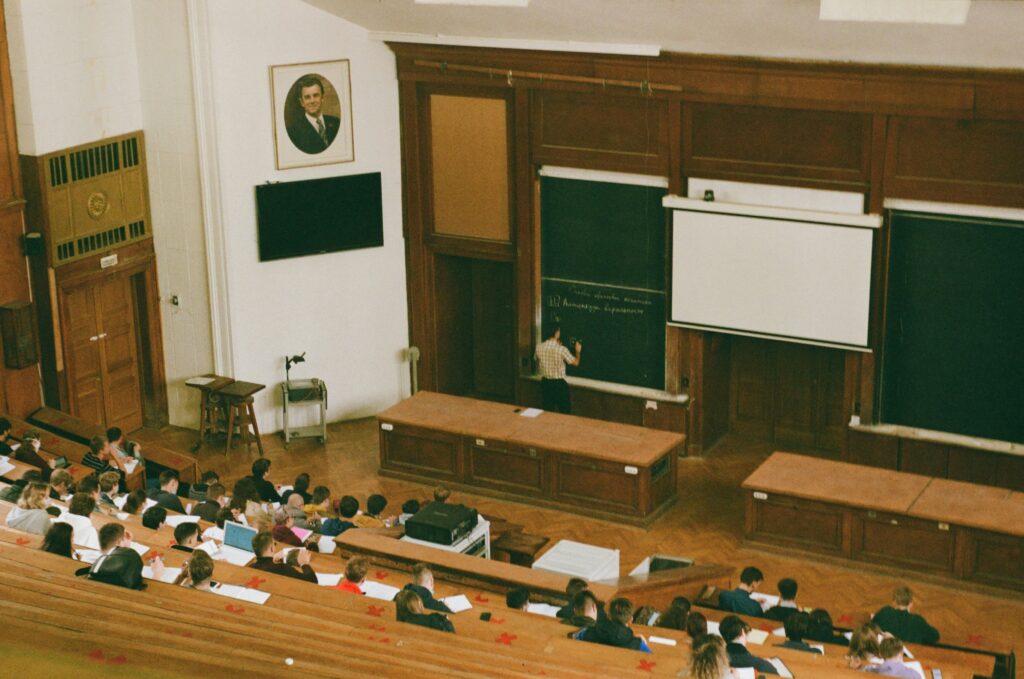
A classroom full of students pay attention as their professor lectures. | Max Shilov, Unsplash
by ELLA CORDLE
Opinion Editor
Class discussions are an essential part of academia. They’re often enlightening and interesting. Peer responses can help shed light on certain aspects of texts, provide a metric for the average consensus of interpretation of concepts and foster new ideas.
Simply put, there’s a reason why most professors include participation as a notable portion of their final grades.
I’m not arguing against class discussions. Personally I find them beneficial as both a speaker and a listener in most of my classes. However, I think a lot of people at this school need a reminder of what is and isn’t appropriate during these discussions. And further, a reminder that our time in classes is precious. We spend too much money to be there for our time to be wasted.
While students should share in the classroom, for their grade, for the benefit to other students and for the benefit to themselves, ultimately everything they share should be academic and not personal. I know that sounds obvious, but I believe the reminder is unfortunately necessary.
Students have become too comfortable in a class setting.The days when we shook in our boots at the prospect of cold-calling are long gone. Nowadays, students who haven’t even read the required content will raise their hand just to listen to the sound of their own voice. I’ve seen students confidently misinterpret poetry, misidentify key information about a text and even admit that they don’t know what they’re talking about while volunteering to share in class.
Students know they have to participate to get a good grade, but are no longer too embarrassed to attempt to speak in class without having done any of the necessary work. They will either make something up or use the topic as a way to segue into a personal story in an attempt to subtly dodge the fact that they didn’t actually complete the reading.
For anyone who needs to hear this: you’re not getting away with it. We can tell.
Being comfortable in a classroom setting is a great thing. So is being comfortable to discuss the uncomfortable. Removing stigma around things like mental health, sexuality and personal struggles in broader society is important. But there is a time and a place. If you don’t have anything meaningful to say in class, you should keep your mouth shut. And if there’s any possibility that any personal information you might be about to share could make the strangers that are being forced to listen to you feel uncomfortable, you should save it for your friends or your therapist.
We can feel comfortable in classes, be friends with our peers and wear sweatpants all we want, but the classroom is still a professional setting. Students need to remember to treat it as such.
Ultimately, if students are struggling with this, professors need to do more to control their classrooms. I know that this is college. This is optional secondary education undertaken by adults. It should be the job of the professor to educate and encourage, not to wrangle students like they’re cattle. But they are the facilitators of class discussions, so they need to step in when the discussions are progressing in a way that isn’t appropriate for the setting.
This is a phenomenon that students across majors are experiencing, and they’re coming to similar conclusions. Celia Golden, a junior double majoring in religious studies and communication and digital studies, shared an experience with this issue. In a class that they took, two students took up a large portion of time with a public disagreement.
“For a 50 minute class, having 20 minutes of it interrupted by people having their own personal argument was really frustrating. It was a total waste of time, and the professor didn’t do anything about it,” Golden said.
While Golden acknowledged that the argument was related to a sensitive topic, they still felt that the professor should have stepped in.
“As a professor, it’s your job to respect the time of your students,” Golden said. “Part of respecting students’ time is trying to mitigate those off topic discussions. And you know, you don’t have to do it in a rude way. You can just moderate the discussion and try and bring it back on track, or at least bring it towards a closing point.”
This may be the reason why professors have a difficult time interjecting when students speak inappropriately in class. If a student says something incorrect and a professor corrects them, they could hurt their feelings. The safer option is to smile and nod and acknowledge that that is one way you could look at things. If a student is sharing something incredibly personal, a professor interrupting them or not reacting the way that student expects could hurt their feelings. So for the sake of sensitivity, professors are effectively held hostage in their own classrooms.
Another student, senior English major Cameron Gormer, doesn’t think that professors should have to prioritize students’ feelings over education.
“That doesn’t make for a good learning institution if the professors have to cater to what the students say and not the other way around,” Gormer said.
Class discussions and participation are incredibly important for students. But they can’t keep happening like this. I am begging students to try harder to find that line of what is and isn’t appropriate to share. And I’m asking professors to more effectively moderate the classroom in the meantime.