UMW students are not as woke as they think they are
4 min read
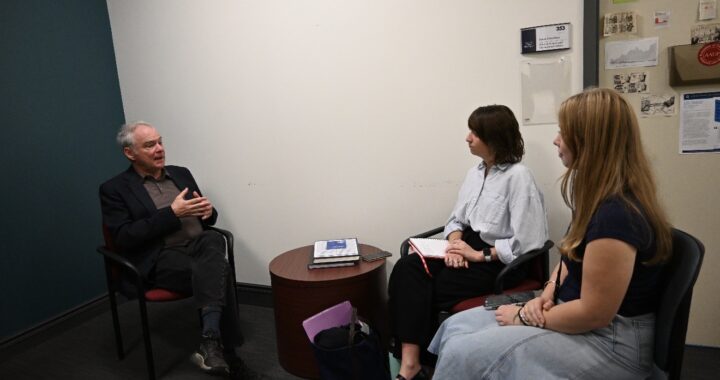
UMW students are steadfast in their beliefs but need to practice their friendly debates. | Anna Goodman, The Weekly Ringer
by ELLI CUSSON
Staff Writer
At an ideal school, every student should feel heard, but in my experience, the University of Mary Washington has a hard time applying this notion. I transferred to UMW my junior year. The previous two schools I attended weren’t a match, so I decided to try another. What I first noticed about students’ behavior at UMW was that there seemed to be no hesitation in regards to giving opinions, because the sentiments were never challenged. Everyone seemed so solid and steadfast in their identities to the point that they seemed incapable of being wrong.
For my freshman year of college, I attended Liberty University, and through that experience, found that UMW and LU sit on two different sides of a spectrum.
These universities’ student populations are prime examples of individuals who were influenced by environments that reinforced their beliefs through repetition. They echo the opinions that they’ve always heard, and because of this familiarity, there’s an incentive to attend a school that already aligns with their beliefs.
Liberty was founded with ties to Southern Baptist Churches in Virginia, whereas UMW was not. As someone who isn’t Baptist, LU students hold many radical opinions, but so do those at UMW.
Both schools have highly vocal, opinionated groups. At one school, there are praises being thrown towards a specific political party, and at the other, curses. Everything is black and white with seemingly no room for negotiation. Liberty is this way because they abide by “The Liberty Way,” which places students in an environment controlled by the school’s religious values. As a result, students will only be exposed to content told from that perspective.
On the other hand, UMW’s administrators don’t implement these same kinds of rules. Instead, opinions are reinforced through student and professor social interactions. The company we choose to keep affirms what we already believe, making it harder for us to enjoy the company of those who disagree. This idea complements the argument that we submerge ourselves in voices that echo our thoughts back at us, instead of branching out to listen to new ones.
In multiple classes I’ve taken at UMW, professors and students have never shied away from putting in their two cents. As a person with beliefs that might diverge from either school’s vocal opinion, I’ve never felt comfortable voicing them.
When I told friends I had made at LU that I was Catholic, they stepped back to process my words as if they couldn’t believe it, but so did UMW students. Neither of the schools offered a tolerant climate to exchange opinions without blowing up in response.
UMW needs to abide by its own values. At our school, we claim to be more open-minded than LU, but we don’t realize that we’re just as much a part of the problem.
Imagine if we did branch out. We could draw comparisons in arguments to see mutual overlap and areas of concern. We’d learn different approaches to solving issues from diverse backgrounds, and aim to find mutual understandings. Not only that, but we would grow in our personal opinions, determining what we value and what we don’t based on opinions that can withstand questioning.
In UMW’s ASPIRE guidelines, it states students should strive to have respect and civility as well as a sense of engagement. I usually keep my religious life private from my UMW friends unless they ask because of fear of judgment.
I’ve had someone stop talking to me because they assumed I might act a certain way because of my religion. We need to acknowledge that as students, we are prone to staying inside our comfort zone of closed-mindedness and do something about it.
I’ve paid witness to casual debates between students that took place on UMW campus, but they weren’t quite productive conversations. Oftentimes, it would be before or after class, brought up because hot topics like Elon Musk and the presidential election were making the rounds.
What stood out to me was these individuals engaging in “debates” weren’t looking to understand new perspectives, but instead waiting for their turn to retort. It was brick wall against brick wall.
The only impact the conversations made were the solidification of each’s own argument. Because there was no give, students became increasingly frustrated. What’s the point of having a discussion when nothing has been accomplished?
This can be changed. It comes down to understanding why students believe what they believe.
We can also educate ourselves while doing so. Instead of thinking of something to contradict what someone else says, ask why they think that way. It might not be your natural instinct to do so, but give it a try.
Debates are meant to be an exchange in which you attempt to have a conversation that enlightens both parties. By listening to what others say, not only are you understanding each other’s background, but you’re also making other students feel heard.
The worst thing that we could do is keep the current situation the way it is. Because if we do, we’ll keep living like hypocrites who only want to listen to someone they can agree with.
UMW has the opportunity to incorporate ASPIRE to its fullest extent. We have the potential to be more than a judgmental student population. Based on how open-minded we want UMW to be, we should aim to be tolerant and open to new ideas, and we can’t do that by pointing fingers at one another and parting ways miserably.