Letter to the Editor: Fundamentals of Furniture Making shows learning doesn’t always happen in the classroom
4 min read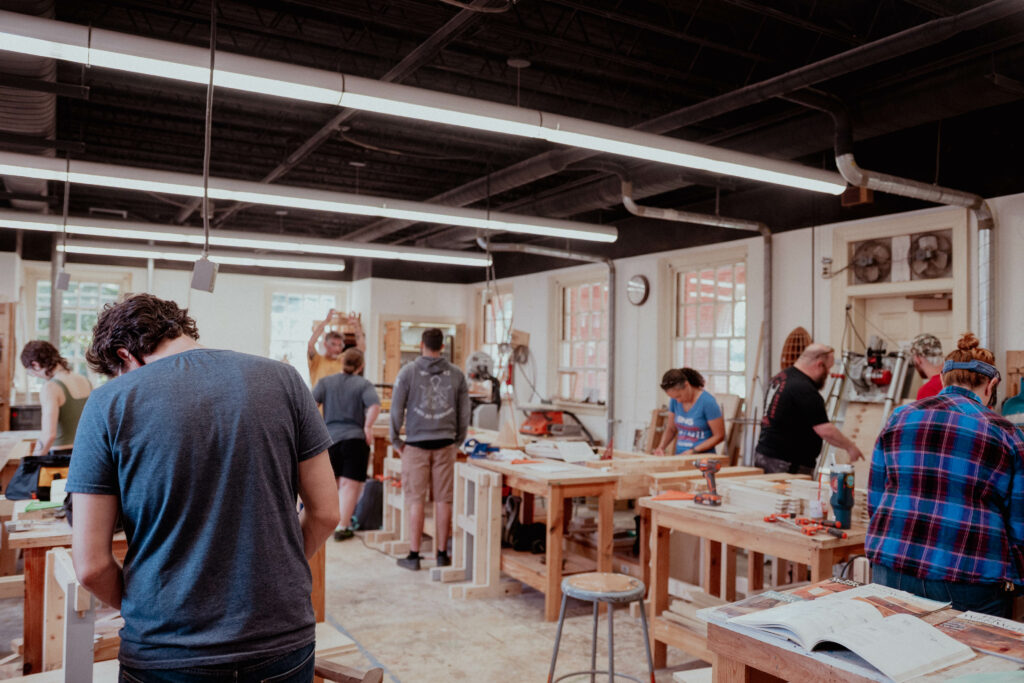
Students taking Fundamentals of Furniture Making created their dream projects. | Photo courtesy of Richard Simpson
by RICHARD SIMPSON
Contributing Writer
When I signed up for the Fundamentals of Furniture Making course this summer, I wanted to learn from someone who truly knew the craft. Professor Lawrence Hinkle isn’t just skilled with wood; he is fun and energetic, has a genuine love for the craft and a wealth of knowledge from a lifetime of experience. He studied with James Krenov at the College of the Redwoods (now The Krenov School), one of the finest woodworking schools in the world, and is a graduate of the Historic Preservation department at the University of Mary Washington. That in itself was reason enough to sign up, but once Professor Hinkle shared some of his ideas for the course with me, I was all the more eager to commit.
We began with a project that seemed simple: building sawhorses. The idea was to build a set of sawhorses using only joinery, without the use of nails, screws or other fasteners. We quickly realized that we would need to be precise with our measurements and remember to measure twice and cut once. With students of all skill levels working side by side, it quickly became apparent that patience, timing and sharing space, tools and responsibilities were essential.
Each student was trained and took turns on the chop saw, table saw, drill press, band saws and sanders. We cut the pieces to length on the chop saw first, then squared them on the table saw. Finally, we used the drill press, a dado blade and a band saw to cut the joints. It was a flurry of activity: the whir of machines and dust collectors, the ringing of saw blades and the percussion of mallets and hammers as they shaped and assembled the parts. With so much energy in the shop, time seemed to fly by.
We worked diligently to complete our sawhorses. Everyone had the experience of chipping away material from joints with chisels, rasps, files and sandpaper, to fit the finished parts together to make a complete sawhorse. It was fun to witness each one come to life. There was a shared joy and gratification in seeing your own or another student finish a set of sawhorses. We all encouraged and cheered each other on.
For extra inspiration before our final assignment started, Professor Hinkle invited Josiah Stinson, a local teacher and woodworker, to tell stories from his classroom and shop. His stories were filled with wisdom and humorous anecdotes. He also brought in examples of his work for us to inspect. His words echoed what Professor Hinkle had shared with us, that woodworking isn’t just about making something. It’s about the journey as much as the result. It is also about problem-solving, respecting the materials, letting the piece take you where it leads, taking risks and learning from your mistakes. We were inspired.
Once the sawhorses were done, we dove into our dream projects. We were given a wide berth, so the studio came alive with variety: a rocking chair, a bench, a footstool, a bed, multiple shelves and a nightstand. Everyone set off on their own path. My path was a three-legged, baseball-themed stool with a home plate-shaped seat and baseball bat-shaped legs. My personal challenge was to create everything out of reclaimed plywood. There were leftover materials from a struck gallery installation. I chose to reclaim and repurpose that plywood. The design was
playful and fun. The serious part was measuring, cutting, sanding and fixing mistakes. Nearing the end, a weak leg gave way. Fortunately, after some reinforcement and some creative problem solving, it stood tall, and I was confident to let it bear weight. That mix of work and creativity was what made the class so special.
By the final, the studio felt like a comfortable creative space. We were all very comfortable working together. For the critique, we shared our stories, expressed our successes and the obstacles we overcame, as well as our frustrations and lessons learned, highlighting the progression from initial sketches to the finished product. Everyone had something tangible to hold and a story to tell about how it came to be. We concluded on a positive note and left with more than we started with.
The structure of the course made it all possible. Five weeks, four days a week, entirely in the shop, and it felt like a woodworking camp for university students. The steady rhythm kept us focused, provided visible progress and created a space for us to work on our projects. It was over before we knew it, and I could have spent the entire summer in the studio full-time. It was a great experience. It was over too soon, but it is a pleasant memory from the summer sessions.
If you’ve ever thought about trying woodworking, or if you’re curious how creativity and craft connect, I can’t recommend this course enough. Whether you want to build furniture or become more comfortable with tools, this class will help you achieve your goals.
In the end, I left with more than a piece of furniture. I left with new skills, new friends and a deeper respect for the craft. Most of all, I was reminded that learning doesn’t just happen in books and traditional classrooms. Sometimes it happens when you put your hands on a material and start to work with it. So if you get the chance to try something new, GO FOR IT!