Frequent fire alarms disrupt campus living
4 min read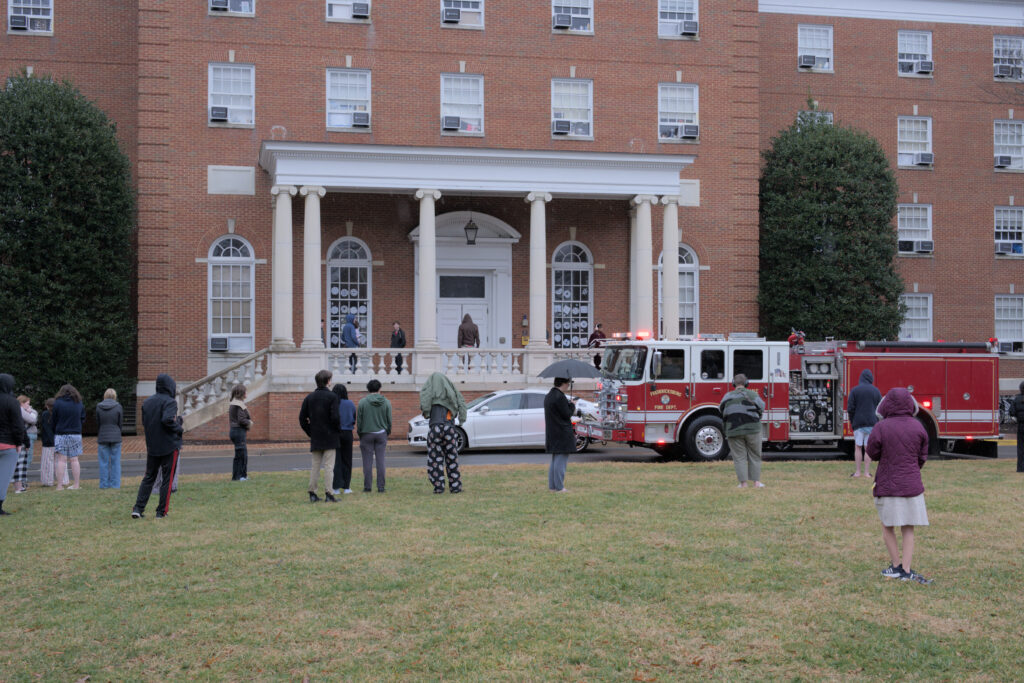
Fire alarms across campus residence halls have disrupted student life this semester. | Violet Ayers, The Weekly Ringer
by ALEXIS HUFF
Staff Writer
Since the start of the Spring semester, there has been an increase in the number of fire alarms going off in residence halls, many reportedly triggered by students accidentally burning food or by maintenance issues. Several buildings have been affected, including freshman dorms and upperclassmen housing.
“In January and February of 2024, we had 36 fire alarms campus-wide, and in January and February of 2025, we had 32 fire alarms campus-wide. Now, in 2026, we had 45 fire alarms go off campus-wide, so it was about 10 additional ones from previous years,” said UMW Chief of Police and Associate Vice President of Public Safety Michael Hall. “I would contribute that from extended time in residence halls due to the snowstorms.”
David Flemming, dean of Residence Life and Housing, acknowledges the recurrence in alarms.
“More often than not, alarms sound due to cooking-related smoke,” said Flemming, “Occasionally, alarms are due to prohibited conduct in the halls.”
For students living in the affected residence halls, the alarms have become a frequent disruption.
Freshman Atticus Shear is a resident in Willard Hall, which has experienced two fire alarms at 11:30 p.m. this academic year.
“We had two alarms go off a week apart, so I got really suspicious, but I go to bed at like nine to ten o’clock, so I was asleep when they happened, and I woke up and I heard a noise and saw the fire alarm clicking,” Shear said.
The frequency and timing of the alarms have disrupted students’ routines.
“It definitely affected my sleep because I had to wake up in the middle of the night for like 30 minutes because then I also have to get back to sleep, so it’s like I have to calm down from being outside,” he said.
Shear says the repetition has made it difficult to respond with urgency.
“Neither time was I like, ‘I’m in danger, I need to get out.’ Both times it was a major inconvenience because I had to get up, put proper sweatpants on because it’s extremely cold outside, and shuffle outside and then stand in the cold for like 15 minutes,” he said.
Shear explains that even though the alarms have impacted his sleep schedule, he hasn’t been stressed about them.
“They didn’t stress me out too much, it was just more annoying than anything because neither time was an actual emergency,” he said.
Residents in Jefferson Hall—an upperclassman dorm—have experienced similar circumstances, causing them to stand in the cold late at night when a false alarm goes off.
Vesper Padgett, a junior classics major, shares her experience as a current resident in Jefferson Hall.
“I live in Jefferson Hall on the first floor. I’ve experienced about three to four fire alarms happening within about a week and a half of each other,” said Padgett.
She also noticed a pattern with the recent alarms.
“I’ve noticed that they either go off in the early-to-mid afternoon or in the evenings,” she said.
Just like the residents of Willard Hall, those in Jefferson Hall have been affected by the frequent alarms.
“They disrupt my sleeping, my showering, and my studying. It makes it hard to focus on studying and taking care of myself when there’s the possibility of a fire alarm going off,” Padgett said.
The sound of the alarms bothers some of the residents, like Padgett.
“They make these horrible, purge siren-like sounds that can really shake a person. I used to be incredibly scared of fire alarms when I first moved into Jeffy, but now they’re more annoying than anything else,” she said. “I don’t even associate them with danger anymore, just a very old building and careless students.”
Lots of responders and resources are deployed when a fire alarm goes off. Hall describes what happens when an alarm goes off.
“The alarm comes in to dispatch, and when we get the alarm, we contact the Fredericksburg Fire Department. They send the response, and we also send the police officer, and during the day, if the safety officer is working, they respond also,” said Hall. “Then the professional on call or the RA responds also.”
Although multiple agencies respond to each alarm, Hall said the role of campus police extends beyond emergency response to include education and prevention.
“The reason campus police get involved is to document the situation and to try to keep it from happening again, from an education standpoint, not a criminal standpoint,” said Hall. “We have to report on anything that happens on campus, not to get people in trouble, but to educate them to make better choices.”
Hall also said that relatively minor mistakes or equipment issues are the cause of the fire alarms, rather than dangerous behavior.
“We try to identify what the problem was, and we work with Dave Flemming so they can make sure it’s not the same student making the same mistake,” said Hall. “Sometimes the alarms go off due to a mechanical issue or human error. Cooking popcorn is a prime suspect, but we don’t see negligence or anything like that.”
In response to the recent incidents, Residence Life is considering additional prevention measures. Flemming gives some helpful reminders to students living in residence halls.
“Read the prohibited items list and be sure to abide by it. The items listed are on it for a specific purpose,” said Flemming. “Avoid burning any items in the residence halls, including candles, incense, cigarettes, cigars, cannabis and vapes. Be sure all safety equipment is in working order- call in an emergency work order for malfunctioning equipment.”