UMW introduces changes to online registration process
4 min read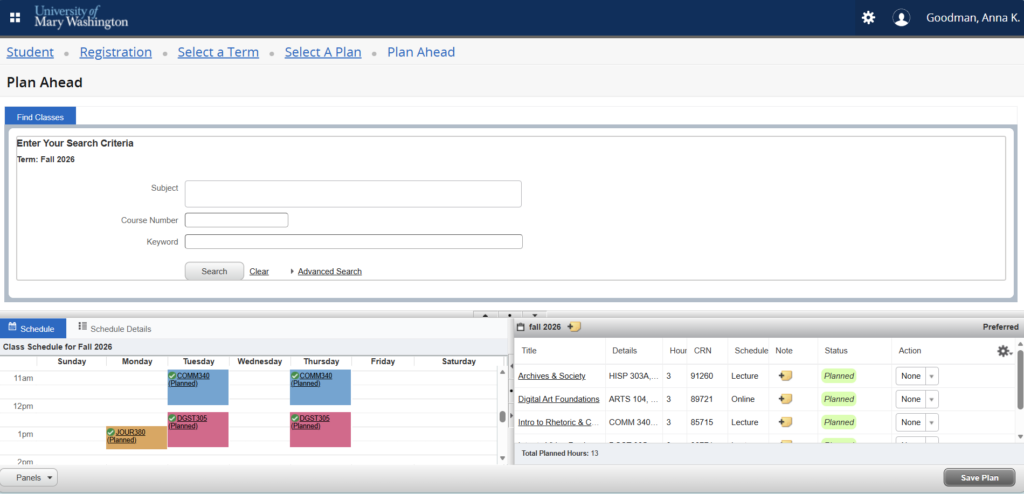
Students registering this semester must now use a PIN to access classes. | Anna Goodman, The Weekly Ringer
by CLAIRE LEATHEM
Staff Writer
According to a March 3 email from Associate Provost and University Registrar Rita Dunston, undergraduate and M.Ed. students will not be able to register for classes or make changes to their schedule until they are given a Personal Identification Number (PIN) from their advisor at their pre-registration advising meeting. Students are provided with a step-by-step instruction list via the announcement email for how to use the PIN.
Dunston explained that this change was implemented to improve the pre-registration process.
“This process helps ensure that students meet with their advisors before registering, as the advisor provides the code,” she said. “This supports better course planning and helps keep students on track for degree completion while maintaining a secure and organized registration process.”
However, the reasoning for the change has a different purpose among staff members. Staff advisors were told that it is due to a progressive system switch.
“As I understand it, it’s the result of the university shift to a new system, a system that is partially underway,” said Anand Rao, professor of communication.
Rao continued to say that the PIN is due to the inability to use the old Banner system, which was updated over the summer.
“What we needed to do this semester, as kind of a stopgap measure, is to move the PIN assignment because lifting holds wasn’t going to work due to the system not being able to support it,” Rao said, explaining that the old system in Banner is no longer available.
Some students, including Anna Woods, a sophomore theatre and education double major, expressed apprehension over the new PIN because of the already stressful nature of class registration.
“I’m not exactly sure why these changes are being made, maybe if they shared the reasoning, I could get behind it, but I think having a PIN just adds to the stress that registration already is,” said Woods.
Other students question the reasoning for the system change in the middle of the academic year.
“I wish they provided more information on why it is necessary to introduce the new system into registration,” said Brady Thompson, a sophomore business administration major.
Some students are concerned that there’s an increased chance of not getting classes that they want.
“I think the PIN is an unneeded change that leaves more room for error in registering for the classes that I want,” said Michael Rupert, a sophomore math major.
Advisors were provided training for the new registration processes via email.
“In my first advising appointment, I wasn’t really sure how to share the PIN, and I pulled up that email, and it included good step-by-step instructions on where I could find it and how to share it,” said Rao.
Despite the information given to professors and staff, Adjunct Professor of Communication and Digital Studies Stefanie Chae empathized with students who were concerned about the change.
“I first heard about it in a department meeting earlier this week. I did not get the reason behind it,” she said.
Chae also said she understands that with limited seating, it’s hard to get a space in certain courses.
“Right now, I’m only seeing the frustrations. I do see a little bit of the positive side, maybe it’s more secure. But wasn’t it secure before?” she said.
Other than an increase in anxiety for getting into desired courses, the real impact on students and professors is the added responsibility and pressure of keeping track of their PIN.
“I am worried that maybe a student will have their advising time come up and they will have misplaced the number, or written it down incorrectly,” Rao said.
Some professors argue that the new system is a positive change.
Communication and digital studies Adjunct Professor Lindley Estes-Thomas believes this will motivate students further to meet with their advisors before registration, ensuring they receive valuable registration and Banner information.
“I think it makes a lot of sense because this PIN requires that you have an advising meeting, and hopefully that means that you’re able to go more thoughtfully into registration and understand the pros and cons of taking each class,” Estes-Thomas said.
While Estes-Thomas believes it will have a positive impact, she too is not entirely sure of the reasoning behind the mid-year change.
“I’m not sure what the function is because I haven’t been involved in those conversations,” she said.
Rao also explained that this change shouldn’t make a big difference in the race to get the courses that students desire.
“It would be a delay that everybody has to go through. So I don’t think it would change anything in that regard,” Rao said.
If students struggle with the new registration system, assistance is available during registration through UMW staff, according to Dunston.
“Students who have questions or need assistance are encouraged to contact their advisor for support,” Dunston said. “Additionally, a registration instruction video is available to guide students through the process. Students are also encouraged to follow the Office of the Registrar on social media platforms for updates.”
The email also made recommendations for forming a schedule ahead of time using the Plan Ahead tool in Banner.
While students and professors have expressed their frustration towards this change, Rao described the overall impact on registration as minimal.
“I don’t think it’s really changed anything about my advising process. For now, the best bet is to make sure we double check the numbers, students and advisors each write them down, and then I keep a copy so that if you, for instance, have trouble, then you can contact me,” Rao said.