FXBG hosts 2,500 protestors for “No Kings”
5 min read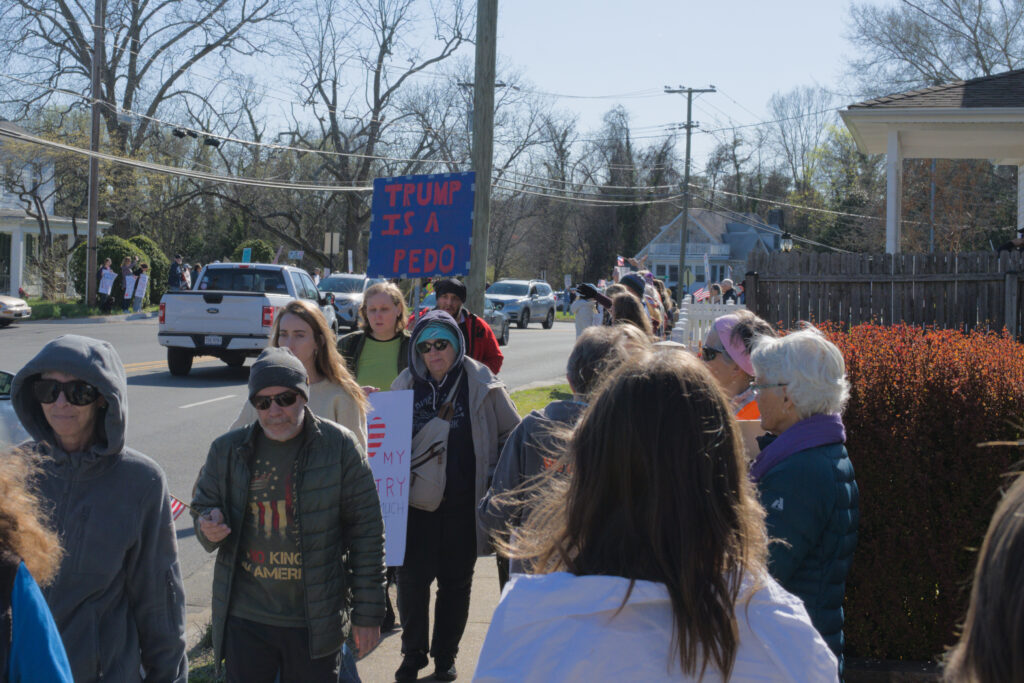
Protesters gather on Williams St. for the “No Kings” protest. | Violet Ayers, The Weekly Ringer
by MEAGHAN VAN DYKE & CHLOE MCCANN
News Editor & Life Editor
Standing on the corner of a busy Fredericksburg street, freshman Katherine Watterson watched as cars drove past the crowded sidewalks lined with community members and their signs.
Watterson found out about the “No Kings” rally after hearing about it from the last protest she attended. For Watterson, attending the rally was important, especially as a part of a newer generation of voters.
“I found a lot of folks that were with me last time at this event didn’t want to come because they didn’t really think that this does a lot,” she said. “And to that end, I would say standing around with signs is important, but it is also important to physically protect your communities.”
On March 28, the Fredericksburg Democratic Committee hosted a “No Kings” rally held on the corner of Williams St. and Blue and Gray Parkway. According to Indivisible’s website, an activist group that’s responsible for organizing “No Kings” rallies across the country starting in June 2025, the protest’s goal is to organize against the Trump Administration and its actions, which many have deemed unconstitutional.
According to Ken Lucky, chair of the Fredericksburg Democratic Committee, the Committee estimated that nearly 2,500 people were in attendance, including several UMW students.
“I think it’s just really important for young people to get out and realize that we can make change,” said freshman Astrid Vargo.
The messaging of the Fredericksburg protest, however, also revolved around the Virginia referendum open to voters on April 21, with many signs saying “Vote yes! On April 21st.”
According to the Stafford County government website, the only issue raised on the April 21 ballot is a proposed amendment to the Virginia Constitution that would allow the General Assembly to adopt new congressional districts, in an effort to “restore fairness in the upcoming elections.”
While the majority of “No Kings” protest attendees were not UMW students, senior English major Madi Waugh, who attended the protest, still believes students should engage with community demonstrations.
“You shape the future that you’re going to inherit. If you’re not engaged in it, then you’re gonna get squashed,” Waugh said.
Additionally, freshman Eliana Sholin emphasized the importance of seeing younger generations at the event.
“I really like seeing the little kids, and that brings me a lot of joy knowing that we’re getting the next generation into it, or their parents are,” she said. “And I just think it’s a good community being out here speaking out for what we want.”
Despite the large turnout at the community demonstration, many attendees urged action after the protest was over. Organizers handed out flyers with a phone number to report Immigration and Customs Enforcement agents and reminded those in attendance to vote “Yes” on the proposed redistricting amendment.
Despite seeing a majority of older people at both protests, Mary Beccelia, assistant director of career education at UMW, stresses the importance of civic engagement in the community.
“We need a full range of diversity, and a lot of people who come to these are in the older range, as I’m sure you can see. Having all types and ages of people is so important,” Beccelia said. “Plus, one of our competencies at UMW is civic engagement. And what are you doing here, but being civically engaged?”
According to Maggie Haggerty, a senior conservation biology major who helped hand out resource flyers at the rally with Watterson and Waugh, building on the momentum of the actual protest is key to advancing advocacy efforts. To Haggerty, the protest should act more as a jump-start for future material action.
“This is a good way to get into that, to meet people in your community who are doing more mutual aid material work, to really start your network,” said Haggerty.
Haggerty added that the most impactful political change begins with local action.
“I would say, as someone who, for a variety of reasons, hasn’t really had the privilege to go out and do this often, this is not the only way that you can start to network and to enact change on the ground in your community,” she said.
Watterson agreed with Haggerty and added that while “No Kings” has faced criticism for not producing enough of a tangible outcome, it’s still an important place for people to connect.
“While there are many valid gripes and concerns about ‘No Kings’ as a protest, I will say the one objective positive that it has is bringing a community together,” Watterson said.
The protest was initially scheduled for Saturday at noon, but was rescheduled due to the “No Gerrymeandering” demonstration opposing redistricting, organized by the UMW College Republicans Club and endorsed by the Fredericksburg GOP Committee and the Fredericksburg Area Young Republicans, which took place from 10 p.m. to 1 p.m. at the same location.
According to Eric Suon, senior cybersecurity major and president of the College Republicans Club, the overlapping times were not intentional, but the choice of day was.
“I knew that we had the same day as the ‘No Kings’ protest, but I didn’t know what time or anything like that, when it was going to be […] I think we wanted it on purpose for it to be the same day and in that spot, but we just didn’t know what time the protest was gonna be,” he said.
The “No Gerrymandering” College Republicans’ protest similarly primarily focused on the upcoming election ballot, arguing against the proposed amendment to the Commonwealth’s Constitution and urging Virginians to vote “No.”
Based on estimates from attendees at the “No Gerrymandering” protest, approximately 75-200 people were in attendance.
There are no future “No Kings” protests officially scheduled at this time, and according to Suon, the College Republicans will not hold a demonstration for the rest of the academic year.
However, despite the political divide, protestors universally agreed on the importance of maintaining the right to protest.
“I think it’s less about what party you are on, and more about showing up to the things that you believe in,” Watterson said. “I mean, ultimately, at the end of the day, it’s not Democrats versus Republicans. It’s up versus down.”
Suon also agreed that everyone has the right to protest, regardless of political beliefs.
“I think as young people, we have the obligation to be active in politics, whether Republican or liberal, because ultimately, the young people are the future, and we have to put the future first for the next generations,” he said.
According to the Center for American Progress, approximately 8 million people attended a “No Kings” rally somewhere in the United States. Waugh is optimistic about the progress initiated by the event.
“I love this country. I think that it’s not the end, and I think that we can make this country so much better than it is,” Waugh said.