Students and politicians take to campus campaigning ahead of upcoming election
4 min read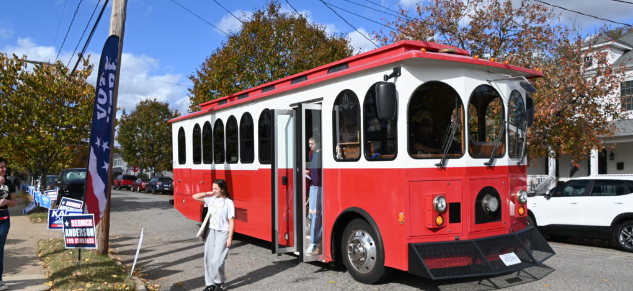
UMW students, political lobbyist groups and candidates are taking action on campus to spread information and campaign for or against the proposed amendments. | Abbey Magnet, The Weekly RingerUMW students, political lobbyist groups and candidates are taking action on campus to spread information and campaign for or against the proposed amendments. | Abbey Magnet, The Weekly Ringer
by SALEM SANDERS & TATYANA RIVERA
Opinion Editor & Staff Writer
As Virginia prepares for its Nov. 3, 2026 general election, students at the University of Mary Washington have an opportunity to consider how their votes could influence the state’s future.
The ballot includes three proposed constitutional amendments addressing reproductive freedom, marriage equality and voting rights restoration. These amendments place decisions about individual rights and legal protections directly before Virginia voters.
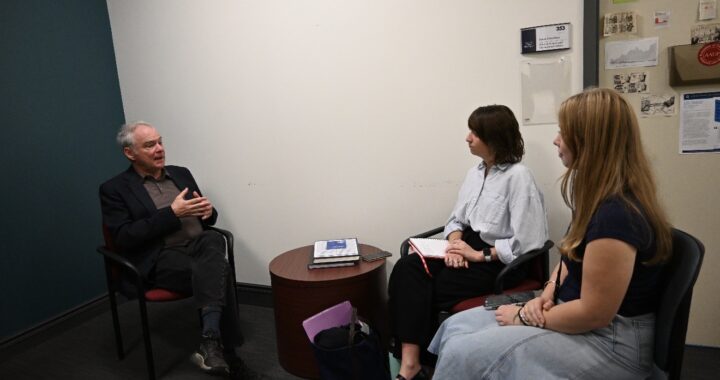
For Sen. Mark Warner, a Virginia Democrat, the election matters beyond choosing political representatives. When speaking with student journalists, Warner emphasized that voters are also deciding which policies those candidates will pursue.
“If you vote this year, not only are you voting for candidates, but you’re literally voting on policy as well,” Warner said.
Shane Maguire, a co-chair of the University of Mary Washington’s Young Democratic Socialists of America chapter (YDSA), similarly argues that students should recognize politics as something that extends beyond election campaigns, and into the places where people study and work.
“Our lives are political,” Maguire said. “We need to extend democracy to every sphere of our life.”
Warner encouraged students to take an active role in the electoral process and make plans to vote before Election Day.
“I strongly urge students to vote early,” he said.
Bert Mizusawa’s team was reached for comment, but did not respond in time for publication.
As midterm elections approach, UMW student groups agree, ramping up campus engagement to educate peers and highlight the importance of voting.
UMW Votes has made it their mission to educate students on their place in political conversations and aim to guide students towards the polls.
When speaking to devoted club members, senior women, gender and sexuality and political science major Sarah Tyree-Hermann and junior political science and communication and digital studies major Alanah Muller, it was made clear just how crucial UMW is to the Fredericksburg area in regards to civic change.
“In terms of numbers, our 2022 percentages outdid major colleges like JMU and W&M when it came to civic engagement,” Tyree-Hermann said. “Winners of local elections here can be determined by a single vote, so we’re really situated in such a unique spot to create a difference in government proceedings.”
In their efforts to drive more engagement from campus, UMW Votes aims to make Election Day less intimidating by providing information and transportation. Muller said the organization planned to staff a table at the Bell Tower from 10 a.m. to 6 p.m. on Election Day and provide a free trolley to transport students to and from the polling location. Students with questions about registration or the voting process can seek assistance there, too.
Tyree-Hermann believes politicians need young voices to determine the future and ensure that college towns are taken seriously in the democratic process.
“You play a much larger role than I think you realize,” Tyree-Hermann said. “Student voting is a movement and I’m happy to be part of it.”
According to the Virginia Department of Elections, Question 1 on the ballot proposes amending the state constitution regarding reproductive freedom, protecting personal choices in reproductive health care. This proposal includes limiting the state’s interference and shielding individuals from punishment based on outcomes of their reproductive decisions.
If Question 1 passes, reproductive freedom would be explicitly protected in the Virginia Constitution’s Bill of Rights. Future laws affecting this right would be subject to constitutional review and would have to meet the amendment’s legal standard.
Ella Osborne, a UMW fellow of REPRO Rising Virginia, a reproductive rights advocacy program, emphasized Question 1’s significance to students and constituents as a whole, regardless of sex and gender identity.
“Nobody gets to escape reproductive healthcare,” she said. “Everybody’s got a body. We have to talk about them at some point, especially if there’s going to be legislation on it.”
“We have done some tabling. We put together hundreds and hundreds of bags of birth control and contraceptives.”
While REPRO Rising Virginia continues to advocate for Question 1, UMW Students for Life opposes the proposed amendment, raising concerns about the potential implications of abortion access and reproductive freedom.
“It could open the door for unintended consequences that’d further harm women,“ Spencer Lombardo, UMW Students for Life president, said.
Lombardo continued to question whether the proposed amendment adequately addresses how it will protect consent for abortions.
“Because the amendment appears vague on how the law would determine whether the patient is truly consenting voluntarily while simultaneously protecting individuals who assist in abortion, it may inadvertently protect such coercion,” Lombardo said.
Like REPRO Rising Virginia, Students for Life is also engaging in on-campus advocacy. Lombardo emphasized that part of the club’s initiative involves tackling the cost-of-living crisis, including a sponsored Diaper Drive through October.
One UMW student who is not affiliated with any political organization, sophomore biomedical science and psychology major Hannah Siraj, said that she is one of the few UMW students who hasn’t seen campus efforts to educate students about the amendments. However, she noted that this could be attributed to where she lives and attends classes, preventing her from regularly passing through Ball Circle, where they might otherwise encounter these engagements.
Siraj plans to vote in the upcoming Nov. 3 election. While she believes national politics can overshadow state-level elections, she recognizes that decisions made at the state level can have significant consequences.
“I feel like people are really concerned about the federal government because of the people in that office, but things at the state level are just as important,” she said.