Professor Majid and UMW Food Recovery Network team up to amplify outreach around food waste awareness
6 min read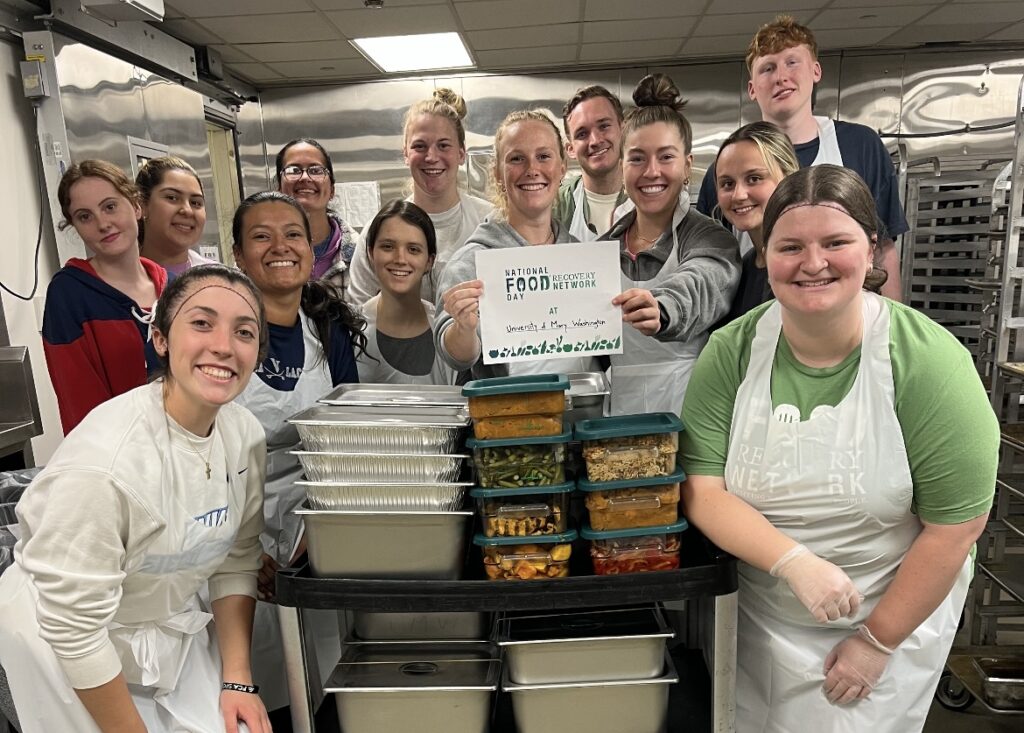
The Food Recovery Network at UMW has recruited volunteers to package thousands of pounds of extra food from the dining hall to send to a local homeless shelter. | Photo courtesy of Pawneez Bahramipanah
by PAWNEEZ BAHRAMIPANAH
Contributing Writer
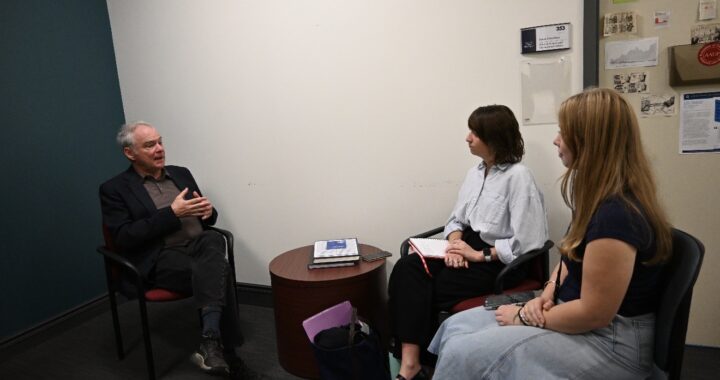
A couple years ago, Kashef Majid, a professor at the University of Mary Washington, was discussing an article with his students, who were taking his course on Alleviating Food Waste, about the Food Recovery Network programs that dozens of college campuses have to prevent surplus food from dining services from going to waste.
One of his students informed him that their very own campus had a chapter of this program and directed him to its Instagram page. He’d had no idea it existed. He found that the account didn’t have any posts from that semester, so he wasn’t sure if the network was active then.
After some digging later, he learned that a University of Mary Washington student named Hannah Jadgchew was running a chapter through the university’s Community Outreach and Resources service program. He reached out to her and started to take action to partner up with her.
This semester, the partnership has resulted in an expansion of the Food Recovery Network to two days rather than just one and increased efforts to raise awareness about it to recruit even more volunteers, through his class called Alleviating Food Waste offered through the College of Business.
“I think the opportunity to volunteer for the Food Recovery Network provides students with practical and hands-on experience reducing waste,” Majid said. “It gives them a sense of how much food goes to waste and how we can help to reduce that waste. Students can and should spread the word on the opportunity to reduce waste amongst their friends and peers.”
This semester, his students have a choice for their final project in his course, which is to create an innovative idea, to do academic research or to volunteer in order to alleviate food waste, Majid said. He said that he thought that working to alleviate food waste would allow students to think creatively and execute practical ideas for the betterment of society.
Majid said that his class in the past has had a focus on the theoretical and conceptual understanding of food waste. The volunteering option is useful because students aren’t simply talking about the problem; they’re working to solve it. The idea for community engagement hadn’t crossed his mind in the previous semester, not until he spoke to Jadchew.
“She had already organized a lot of the logistics for the first day, so it’s simply a matter of carrying that over,” he said. “Things like where do we get the trays, where does the food go, how do we package it up, all those logistics that are necessary, she had already got down.”
Jadchew said it was nice that Majid recognized her work and offered his help to expand the network.
“We were really excited as we were getting attention from other people, and the fact that other people wanted to get involved and we could extend this operation to two days is awesome,” she said. “Now, we’re recovering food from the entire week of the dining hall, so none of it is getting disposed of unless it actually does go bad.” Hannah was amazed by how the network recovered a total of 425 pounds of food in only the first two weeks of people volunteering on Thursdays.
The volunteers are responsible for transferring the surplus food leftover in the dining hall’s dishes into food storage containers. The Community Outreach and Resources leaders then place lids on the containers, wrap rubber bands around them and weigh them to record how much food has been recovered before placing them on a rack for people to drop them off at the local Thurman Brisben Homeless Shelter in Fredericksburg, Va.
In addition to working on food recovery, the students are trying to spread the word to prevent the program from returning to operating on Mondays only, Majid said. Majid said that he thinks that food insecurity is senseless because we have enough food available and that the Food Recovery Network program is wonderful because it can give the food that would otherwise be thrown away to those in need who may be food insecure.
“We waste, on average, maybe 400 pounds a day of food at the dining hall,” Majid said. “If one person needs one pound of food a day, the amount of food we’re wasting could feed about 400 people a day.”
The Food Recovery Network was founded in 2011 at the University of Maryland by a group of college students who watched people throw away food at their campus dining halls every day while members of their community faced hunger. Today, it brings together more than 8,000 college students, food suppliers, farmers and local businesses across the U.S. to fight against climate change and hunger by recovering surplus food from across the supply chain and donating it to local nonprofit organizations that feed people facing hunger.
Majid said that he does not know of another university that has a class that helps with the Food Recovery Network and that what he is doing at the University of Mary Washington is uncommon. The students in his food waste class are volunteering for this program because it aligns with the purpose of the course, but at other colleges that have an active chapter, the students will join themselves without any connection to a class, he said.
“Volunteering for the Food Recovery Network has been pretty easy to be honest,” said Jordan Doss, one of the volunteers from Majid’s food waste class. “You come in, it takes less time than you think, it’s not as hard as you might have expected it to be.”
Doss didn’t expect the amount of uneaten food from the dining hall that the volunteers end up packing to be as much as it is, she said. She said that she hopes that other University of Mary Washington students begin to volunteer and thinks that it’s a good thing to continue the program. Doss thinks that Majid’s food waste class helps to teach people about what the Food Recovery Network is doing and keep it in operation as each new group of students taking the course can continue it, she said.
Majid hopes to replicate the program’s current operation on Mondays and Thursdays in the semesters to follow, whether he is teaching his food waste course or not, he said. While he hasn’t thought of any specific plans to spread the word about the volunteering opportunity, he said that he will share information about the program with his students in his food waste class and hopes that they share it with others.
Majid may create a campus club or use social media to help spread the word, he said. When he isn’t teaching Alleviating Food Waste, he said that he would spread the news about the Food Recovery Network throughout the College of Business through the other courses that he teaches, and he hopes that other faculty members do too.
“Definitely when I teach the class, it won’t be an issue to ensure that students are actively volunteering because it will be an option that they can do for academic credit,” he said. “But when I’m not teaching the class, to get students to volunteer, it’s more about emphasizing communication and getting buy-in and getting students involved. I think that would be the big thing, especially across campus, not just in the College of Business, and getting people to know that they can volunteer.”