UMW’s President’s Council for Sustainability petition advocates for renewable energy plan
4 min read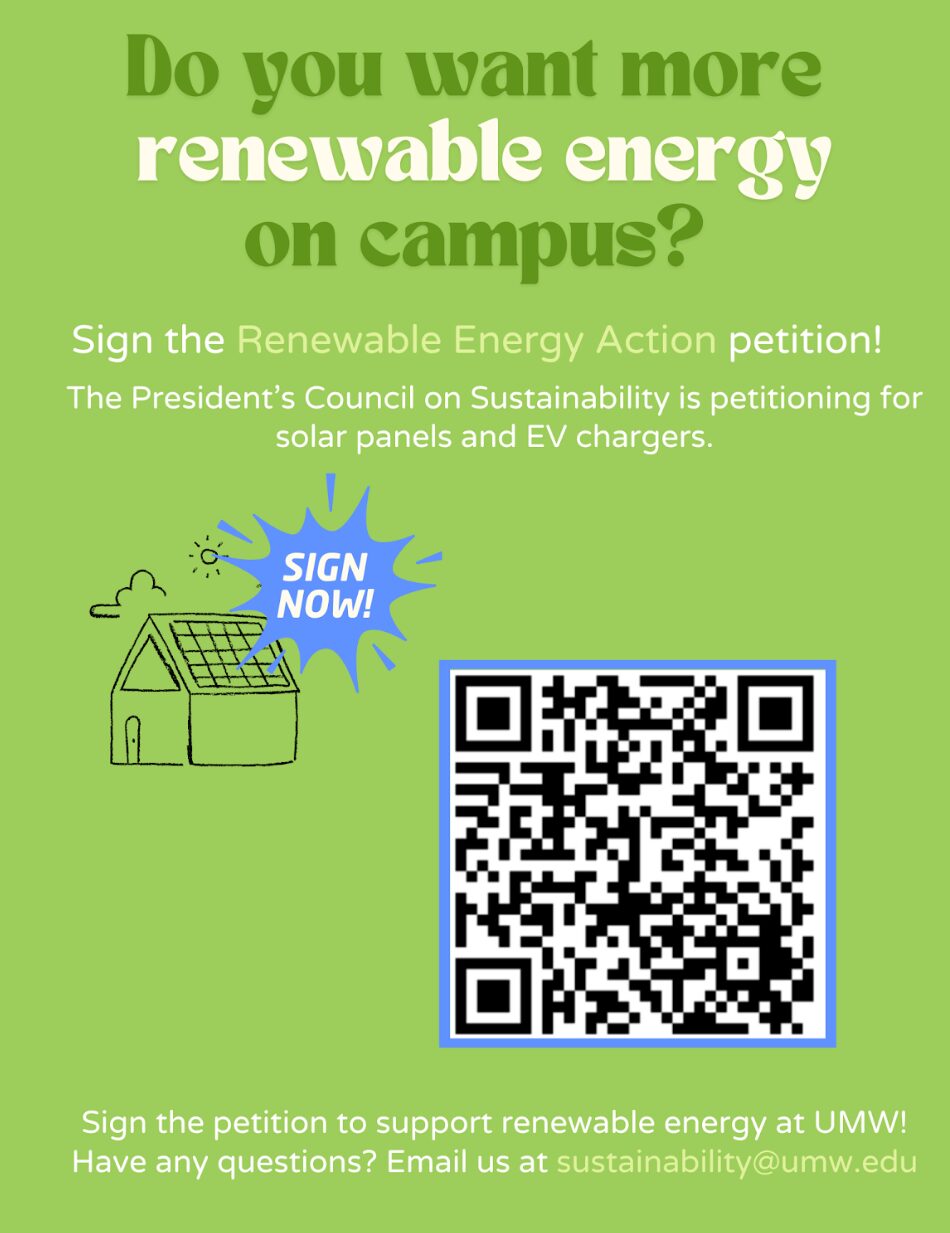
A QR code on the PCS flyer takes students to the petition. The petition currently has over 300 signatures. | Photo Courtesy of Kate Stoneman
KATIE CRADDOCK
Staff Writer
The UMW President’s Council of Sustainability is circulating a Renewable Energy Action Petition to encourage the installation of solar panels and increase the number of electric vehicle chargers on the Fredericksburg campus. While nearby public institutions like Germanna Community College and the College of William and Mary are implementing renewable energy programs, including solar panels, UMW has yet to follow suit.
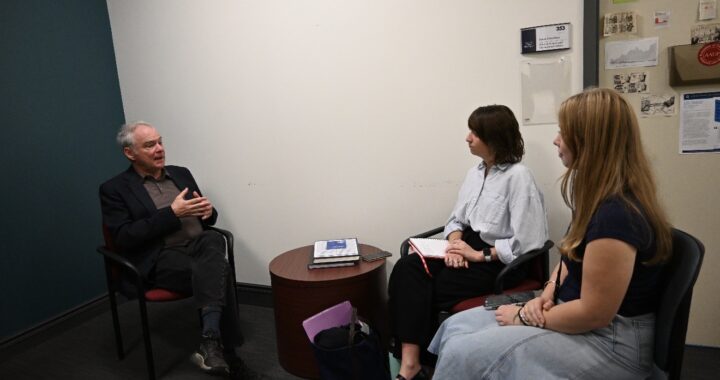
“We wanted to show the administration, the Board of Visitors, the President, that the UMW community wants to see sustainable action and wants to see renewable energy on campus,” said Kate Stoneman, a senior environmental science major and co-chair of the President’s Council of Sustainability. “We’re doing that through the petition and showing that these signatures mean that the UMW community cares about the environment.”
The PCS was established in 2009 and consists of students, faculty and staff dedicated to the effective implementation of sustainability efforts at UMW.
“One of our goals is renewable energy, and particularly that we want rooftop solar on our campus,” said Associate Professor of Earth and Environmental Sciences and PCS Co-Chair Pamela Grothe.
Stoneman says UMW discussed incorporating sustainable energy practices on campus in the past, but those plans fell through.
“We got to a point where there was actually a company looking at the school and evaluating all of the buildings to see where solar panels could be put,” said Stoneman.
Multiple buildings on campus, such as the Anderson Center, Goolrick Hall, Woodard Hall and the Simpson Library, were identified as compatible with solar panels.
“It got shut down, and it hasn’t been talked about since,” said Stoneman. “And so I was getting somewhat frustrated with the fact that that wasn’t being moved forward,”
As institutions across the Commonwealth adopt sustainable practices, Grothe says UMW has the opportunity to emerge as a leader if the university were to implement renewable energy on campus.
“It’s part about the appearance that we should be leaders as a public university. We should be the leaders in the community, showing that this is what needs to be done,” said Grothe. “It makes a statement. It shows both prospective students and current students that we are serious about these issues, that this is important, that we want to be leading the way.”
An article published by the FXBG Advance notes that on a recent Regional Solar on Schools Report Card, UMW received a grade of “Unsatisfactory Progress,” meaning the university lags behind other public school systems in the greater Fredericksburg area.
“I was just reading an article from Fredericksburg Advance, and it literally says, ‘University of Mary Washington currently has no plans for solar,’” said Grothe. “We are being called out in the local newspaper for not doing anything for it.”
Grothe says failure to take action on this issue also has the potential to affect recruitment of prospective students.
“I think it’s going to ultimately affect prospective students’ decisions to come to Mary Washington, because they’re going to see that we’re not serious about these issues,” she said. “Why are they going to want to come to a university that seemingly doesn’t care about climate change?”
Some students, including Abbey Fielder, a senior environmental science major, are passionate about sustainability on campus and hope the petition will encourage UMW administrators to take action.
“I think with this petition the school will realize that we do actually notice and care about sustainability and environmental health,” said Fielder. “It makes for a much more protected/guaranteed future in terms of keeping up with energy demand as well as protecting biodiversity and the health of the environment.”
For practical solar panel installation, PCS recommends utilizing a Power Purchase Agreement, which is a solution more financially manageable for the university. In this agreement, the solar company would pay for the solar panels and installation, and UMW would buy the renewable electricity back at a reduced rate.
“In the long run, we would save money through that process, and then we don’t have to worry about the maintenance on the solar panels, because we don’t own them,” said Grothe, about the agreement.
Stoneman says PCS hopes to get 500 signatures before bringing the petition to the UMW administration.
“We can’t show it to the administration or the president until we get a certain amount of signatures,” said Stoneman. “300 signatures isn’t necessarily enough, which is why we were kind of reaching for 500 at least.”
Moving towards sustainability doesn’t just mean solar panels; PCS has other ideas that would reduce overall energy usage on campus, as well as promote sustainability. Potential proposals include installing LED lights and putting stronger envelopes—the barriers between internal and external enviornments—around some of UMW’s older buildings.
“One way that we reduce our carbon footprint is not only to move to renewables, but reduce our overall energy usage,” said Grothe.
The main difficulty with these initiatives, according to Fielder, is the lack of funding.
“I think UMW tries to promote sustainability but the sustainability department lacks participation and funding so many of their initiatives fall through,” she said.
Stoneman also commented on how the influence of PCS is constrained by the lack of budget.
“In terms of money, the Office of Sustainability has a very small budget. We have no budget, so we don’t have much influence,” Stoneman said. “And so getting the student body involved, brings a lot more to the table in terms of sustainability.”
Even with limited funding, PCS leaders believe the petition, along with student voices, can create change.
“We should be leading the way and setting an example, and we’re not,” said Grothe. “We’re falling behind.”