Social media apps amplify stalking concerns
6 min read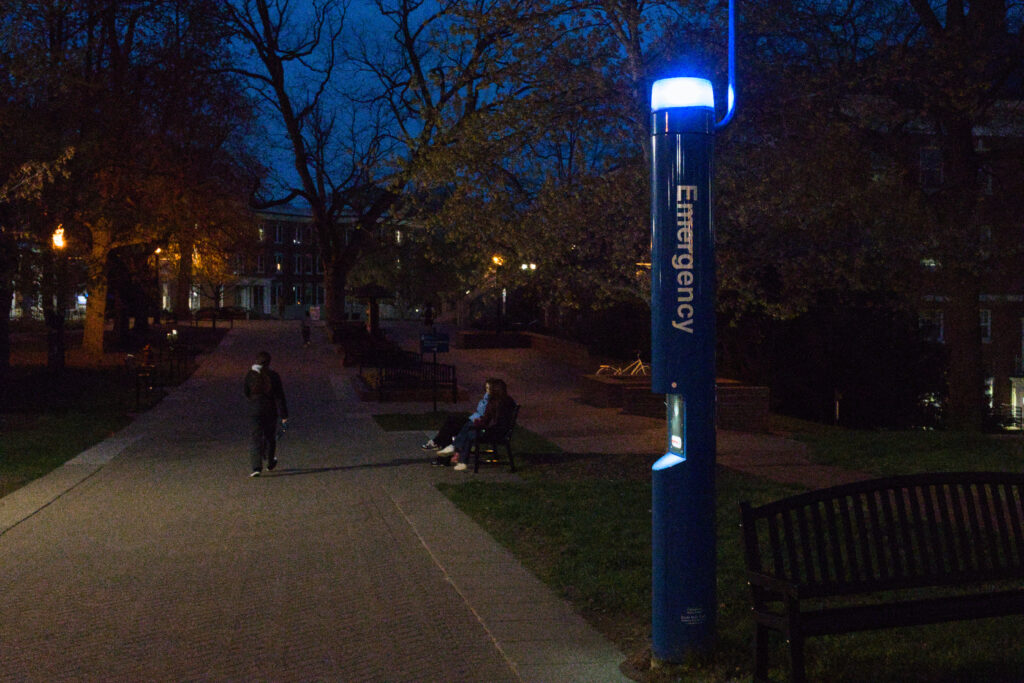
While reported stalking cases have not increased this academic year, fears around stalking have. | Violet Ayers, The Weekly Ringer
by ALEXA DELACONCEPCION
Staff Writer
In recent weeks, conversations of alleged stalking and suspicious behavior at UMW have ramped up across the UMW community online and on campus, as students come forward with experiences of being followed, watched or made to feel unsafe.
Anonymous posts made by users on the mobile app YikYak have amplified concerns and facilitated information-sharing among the student body. While official data collected by the UMW Police Department indicates a decrease in reported stalking incidents, many students believe the issue extends beyond what is formally documented.
“Someone I know was stalked on social media,” said sophomore education major Cindy Miles. “[They also] witnessed/experienced incidents within their club and the gym–their safe spaces on campus.”
According to the UMW Police Department’s crime log, there have been four incidents categorized as stalking within the 2025-2026 academic year, two of which occurred in the past month. These incidents include reports of being followed, repeated unwanted physical contact and other behaviors that may fall under the broader definition of stalking. The 2024-2025 academic year saw a total of six incidents.
Stalking, as defined in UMW’s Title IX Policy, is “engaging in a course of conduct directed at a specific person that would cause a reasonable person to fear for their safety or the safety of others and/or suffer substantial emotional distress.” These behaviors can range from physical following to persistent social media contact.
According to UMW Chief of Police and Associate Vice President of Public Safety Michael Hall, multiple reports may sometimes stem from a single situation, further complicating how incidents are recorded.
“Two or three people talking on a social media platform could make a report, and in essence, it deals with one person,” said Hall.
The recent YikYak posts have contributed to a heightened sense of awareness and, in some cases, anxiety among students. One YikYak poster joked that the students’ sharing similar experiences are inspiring a “MeToo” movement on campus, a social campaign against sexual abuse and harassment.
Despite the uptick in student discussion, Hall emphasized that students should not be afraid and that if an incident does occur, the university will take those allegations seriously.
“We don’t believe the campus is in any danger,” Hall said.
Students have been talking more openly about their alleged experiences, creating a perception that stalking and similar behaviors are becoming more common, even if the data shows otherwise.
“I remember in my freshman year, talks of stalkers kind of felt like urban legends, like a ‘beware of bigfoot’ situation. Now we are seeing these stalkers and [their] defining traits and things—we all kind of know them in one way or another,” said senior sociology major Cortland Rose.
The weight of the allegations made in these posts has prompted increased discussion about campus safety and has played a significant role in shaping that perception.
“I think all areas are relatively safe because of the blue lights, but at the end of the day, this is an open campus, so anything can happen at any time. It’s always smart to be cautious,” Rose said.
Junior communication and digital studies and studio art major Riley Munford said that while she has never been stalked, she has heard of troubling instances affecting her classmates, and believes the response from the university is inadequate to prevent or respond to criminal incidents.
“I do not think administration is doing enough to take action in a timely manner that makes students feel safe,” Munford said. “I’ve heard of multiple cases of reports needing to pile up before any action is taken and it makes me feel like the [student] body isn’t being heard.”
While YikYak posts are often anonymous, the topics of conversation have predominantly been about female students.
“The cases that I’ve heard of recently are primarily targeting women, so it also makes me and some of my friends feel like the university doesn’t take women seriously,” Munford said.
For many students, the concern is not only about the reported and documented incidents but also about those that go unreported. One female student, who was granted anonymity because of ongoing safety concerns amid issuance of a no-contact order in relation to a criminal stalking incident, recalled the hesitation to formally report her case.
“The cops on campus helped a lot, but it’s crazy how bad the bystander effect is,” she said. “It went on for a few months until I realized I really had to do something about it. I was worried I was overthinking it in my head, and if I reported it nothing would get done.”
This hesitation reflects a broader challenge that universities face in addressing stalking, as individuals may not always be sure whether their experiences qualify as reportable behavior or may feel uncertain about how to seek help.
University officials stress that one of the biggest challenges in addressing stalking is underreporting or delayed reporting. Hall emphasized the importance of contacting campus police as soon as a concerning situation occurs.
“Don’t wait and talk to your friends,” he said. “I’m not saying don’t talk to your friend—I’m saying, if you feel at that moment someone’s stalking you or following you or something like that, call us when it’s happening.”
In some cases, early intervention can help give students clarification for situations that may not actually involve stalking. Hall described instances where individuals believed they were being followed, but further investigation revealed coincidental patterns, such as overlapping schedules.
“I’d rather work through something early on and determine it’s nothing, so the student doesn’t feel anxious and worried unnecessarily,” he said.
Regardless, officials like Hall emphasize that all concerns are taken seriously and that students are encouraged to come forward, even in the face of uncertainty. When reports are made, UMW Police can investigate, increase patrols and coordinate with other campus partners, including the Title IX office, which helps students address sexual and gender based discrimination and harassment, the Office of Student Conduct and Responsibility, which promotes an environment for support and education for students and Residence Life.
“There are so many different layers of support,” Hall said. “The quicker we get that information, the quicker we can deploy resources.”
Beyond law enforcement, UMW offers a range of resources for students who may be experiencing stalking. The Title IX Office can assist with formal complaints, protective measures such as no-contact orders and academic or housing accommodations. Confidential support is also available through campus counseling services such as the Talley Center.
Whether the current moment reflects a true increase in incidents or simply greater visibility remains unclear. However, the combination of student experiences, online discussions and official data highlights the complexity of the issue.
Hall emphasized that maintaining campus safety is a shared responsibility.
“Everyone has a vested interest in the community and safety,” he said. “The quicker we get firsthand information, the quicker we can support the individual and the community as a whole.”
As conversations about stalking continue both online and offline, university officials encourage students to rely on verified resources to report concerns directly. While social media platforms may amplify awareness, they stress that accurate reporting and timely communication are essential to ensuring student safety.
“The University of Mary Washington is committed to providing a safe, respectful, and inclusive learning and working environment for all members of our community. We take reports of concern seriously, address them through established policies and procedures, including Title IX, protect the privacy of all individuals involved, and provide supportive measures based on the individual situation,” said Executive Director of University Communications Amy Jessee.
UMW provides resources for students who may be experiencing stalking or other forms of harassment on the UMW Safety Resources page.
Meaghan Van Dyke and Chloe McCann contributed to the reporting of this article.