Time to turn off the stove and plug in the air fryer
4 min read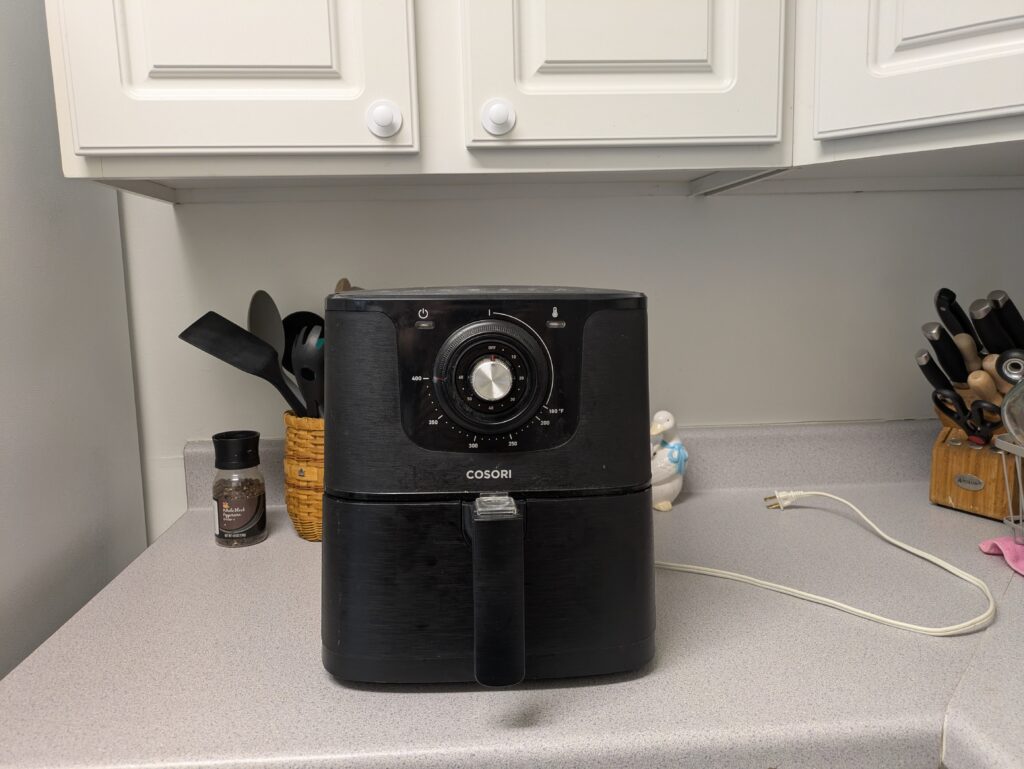
The air fryer is a convenient alternative appliance for many students living in an on-campus apartment. | Ella Cordle, The Weekly Ringer
by NICHOLAS CHAMBERS
Staff Writer
Overall, there are many benefits to living in the Eagle Landing Apartments—one of the UMW’s premier living spaces for upperclassmen and graduate students, made up of two five-story buildings housing up to 624 total students each semester. You get the feeling of being off-campus while still having easy access to everything via the UMW pedestrian bridge that connects the main campus to Eagle Village. As well as proximity to the resident parking garage and a fully furnished apartment with a kitchen, which is a major upgrade from dorm living.
The living arrangement is mostly great. However, a glaring problem with the student experience in Eagle Landing lies in the kitchen ventilation.
“I can smell when my floormates on the north side burn their food,” said Luke Smith, a sophomore business administration major and Eagle Landing south side resident.
He continued, “I can’t really blame them. My roommates and I experience some of the same challenges in our room, and we don’t even burn our food. The smell after cooking can last for days.”
Currently, the only source of air ventilation in the Eagle Landing kitchens is a built-in unit located under the microwave.
“We’ve tried everything,” said sophomore Collin Clarkson. “We keep multiple air purifiers in the living room, just for the purpose of breaking up the smoke. We’ve cooked with every window opened in our apartment, and we’ve still set off the fire alarm multiple times.”
Stories like this make you question the overall fire safety in a five-story building with 156 full-sized kitchen spaces within its walls.
“I find the constant fire alarms to be very annoying,” said sophomore pre-med major Samantha Farmer. “I’m always wondering if there is actually a fire in the building and if I should be evacuating for my own safety.”
When a problem becomes so pervasive that it creates near campus-wide consensus, the solution doesn’t need to be overly complicated. For students navigating Eagle Landing’s ventilation woes, the solution may be a compact but mighty kitchen compliance already permitted in resident spaces.
Compact, clean and authorized in the UMW Student Handbook for apartment living, the modern-day air fryer addresses ventilation issues in a relatively inexpensive and noninvasive manner. By circulating heat internally within an enclosed system, it significantly reduces smoke and odor emissions compared to traditional open flame cooking. Unlike stovetops, which release heat, grease particles and lingering smells directly into living spaces, air fryers contain most byproducts of cooking within the appliance itself.
I was first introduced to the revolutionary air fryer by my roommate, sophomore business administration major Colin Mitchell, who swore by its functionality.
“It’s a game changer for me,” he said. “I have celiac disease, which gives me intestinal issues when I eat gluten. Cooking in a shared space like an oven is always dangerous with my condition.”
Mitchell continued, “The air fryer is so easy to use that I cook everything in it. The food comes out crispier, and the experience gives me peace of mind, knowing I won’t get sick from cross-contamination.”
Beyond ventilation, air fryers also present a lower overall safety risk compared to conventional ovens. Individuals are less likely to burn themselves transitioning foods in and out of a small drawer compared to sticking their arm into a large oven. Not to mention, most air fryer models have an automatic shut-off button to combat overheating, something that complies with the main constraint against many household kitchen ovens today.
College is a place where many young adults are experimenting with their talents in the kitchen, on tight schedules. The air fryer is a system that chops the preheating process in half and allows for a “set-it and forget-it” convenience for student efficiency. Certain models incorporate check reminders, to shake and flip foods, and some even have preset meat settings that provide the perfect cook durations for crispy cuisine. You can also say goodbye to managing hot oils as air-fried dishes produce healthier alternatives to cooking, without the grease or grime.
Modern air fryers are compact enough to fit comfortably on a kitchen counter, large enough for most student meals and small enough for easy storage. Prices are student-friendly, ranging between $50 to $120, and most models feature dishwasher-safe trays and baskets that make cleanup hassle-free. They come in all shapes, sizes and even colors to fit your kitchen countertops, cabinets and aesthetics.
As students continue to adapt to apartment-style living at Mary Washington, the shift towards smart appliances feels less like a trend and more like a practical evolution. Air fryers are by far the best way to reclaim your cooking experience at a university, and they will only become more popular as technology innovates and large kitchen designs become less popular over the next 15 years.
The answer is clear: we just need to realize it. Sometimes the fix for a widespread problem isn’t a costly renovation, but a simple investment. For Mary Washington’s Eagle Landing residents, that resolution might just start with plugging in an air fryer.